
Newsletter Articles
Coast Live Oak: California Native Tree Care Guide
Written by Richard Flowers, ACCNP
The coast live oak (Quercus agrifolia) is an evergreen California native oak and one of the signature trees of Southern California. It grows into a broad, long-lived shade tree, feeds and shelters hundreds of native species, and is beautifully adapted to our dry summers. The single most important thing to know: once a coast live oak is established, do not give it summer water near the trunk and do not plant a lawn under its canopy, because summer soil moisture at the base invites the root and crown rots that kill mature oaks. Water only young trees to get them established.
Quick answer: Coast live oak is an evergreen native oak that can reach roughly 70 feet tall and wide and live more than 250 years. Plant it in full sun with room to grow, water a young tree to establish it (about weekly the first year, then monthly until it is around 10 feet tall), and after that keep summer water at least 10 feet from the trunk and keep lawn and thirsty plants out from under the canopy. Its biggest care risk is root and crown rot from too much summer moisture.
| Attribute | Detail |
|---|---|
| Botanical name | Quercus agrifolia |
| Type | Evergreen California native oak |
| Mature size | About 19 to 82 feet tall; can reach roughly 70 feet tall and wide |
| Lifespan | Often more than 250 years |
| Sun | Full sun |
| Water once established | None near the trunk in summer; keep water 10+ feet from the base |
| Wildlife value | Acorns and host plant for 270+ native species |
What Is a Coast Live Oak?
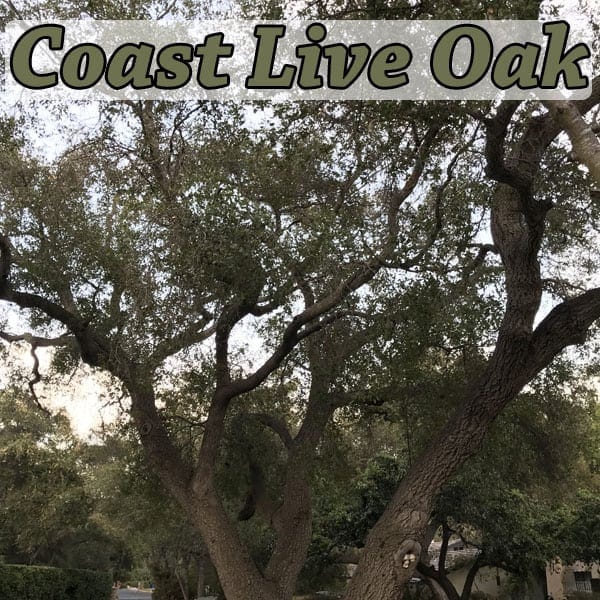
The coast live oak is an evergreen, drought-resistant native oak; it keeps its leaves year-round, flushing new growth from February through April as it sheds the old ones.[1] Its native range runs from Mendocino County in the north down into Baja California, including the coastal, Transverse, and Peninsular ranges of Southern California, usually below about 3,000 feet of elevation.[1] Mature trees typically stand anywhere from 19 to 82 feet tall with a broad, dense, spreading crown, and a garden specimen can reach roughly 70 feet tall and about as wide.[2] These are long-lived trees; individual coast live oaks can live well over 250 years.[1] Each fall and winter the tree drops large acorns, with heavy crops about every two to three years.[3]
Why Plant a Coast Live Oak
If you have the space, few trees give back as much. The coast live oak is a wildlife powerhouse: the California Native Plant Society counts roughly 25 native bee species, 18 native butterfly species, and 248 native moth species visiting it, with about 265 butterfly and moth species using it as a host plant, and more than 270 native species relying on it for food and habitat overall.[4] Its acorns are a keystone food, making up more than half of the fall and winter diet of acorn woodpeckers and scrub jays and feeding deer, rodents, and many other animals.[1] On top of that it offers year-round evergreen shade and, once established, thrives on our natural winter-wet, summer-dry rhythm with no extra water.[3] For other options, see our guide to native Southern California trees.
Coast Live Oak Pros and Cons
Pros:
- A true California native, perfectly adapted to our climate once established.[1]
- Evergreen, so it gives shade and screening all year.[1]
- Exceptional wildlife and pollinator value (270+ species).[4]
- Very long-lived, often beyond 250 years.[1]
Cons:
- Large eventual size, up to about 70 feet tall and wide, so it is not a tree for a small lot.[2]
- It sheds old leaves in spring and drops acorns in fall, which means some litter.[1]
- It is fussy about water at the trunk and cannot share its root zone with a lawn (see care below).
- It is slow to establish, though it grows at a moderate pace once its roots take hold.
How to Grow and Care for a Coast Live Oak
Give a coast live oak full sun and plenty of room, then think about water in two stages. A young, newly planted tree does need water to get going: about once a week through the first year, then roughly monthly until it is around 10 feet tall, after which you should avoid watering it directly in summer.[4]
Once the tree is established, the rule flips, and this is the most important thing in this whole guide. University of California oak specialists caution against applying summer water to established native oaks, especially near the base of the tree, because fungal diseases such as oak root fungus (Armillaria mellea) and crown rot (Phytophthora) are associated with oak death under high soil moisture.[5] If a prolonged drought forces you to give an old oak some water, keep it at least 10 feet away from the trunk, out in the outer two-thirds of the root zone.[5] In practice that means keeping sprinklers off the trunk base, not planting a lawn or thirsty plants under the canopy, and maintaining a mulched, turf-free zone out to the dripline; established oaks that have never been irrigated should simply be left dry.[6]
Common Pests and Problems
The oak’s biggest threats are the two root-and-crown rots already mentioned. Oak root fungus (Armillaria) takes hold in soil kept too wet and has no fungicide cure, so prevention through dry soil at the crown is everything.[6] Phytophthora root and crown rot is likewise driven by saturated soil, so good drainage and letting the soil dry between any waterings are the key defenses.[7]
Two insect and disease threats are worth knowing by name. Sudden oak death, caused by Phytophthora ramorum, can infect coast live oak and cause bleeding bark cankers, but it is primarily a problem in coastal central and northern California, where it is tied to the presence of California bay laurel.[8] The goldspotted oak borer (GSOB) is the one to watch in our area: it was introduced to San Diego County on imported oak firewood, has since reached Riverside County, and can kill larger oaks, which is why you should never move oak firewood.[9] On the milder side, the California oakworm can defoliate a tree in some years, but healthy oaks tolerate it and treatment is usually not recommended,[10] and the odd-looking oak galls you may see are cosmetic and need no management at all.[11]
Thinking about planting a coast live oak or caring for one you already have? Visit any Green Thumb Nursery location and our certified staff can help you choose a healthy young tree and get the siting and watering right from the start. For more native ideas, see our guide to the best native plants for SoCal yards and our low-maintenance shade tree options.
Coast Live Oak FAQ
How big does a coast live oak get?
Coast live oaks usually reach 19 to 82 feet tall, and a mature garden tree can grow to roughly 70 feet tall and about as wide with a broad, spreading crown, so it needs plenty of room.[2]
Should you water a coast live oak in summer?
Not once it is established. University of California specialists advise against summer water near the base of an established native oak, because wet summer soil promotes the root and crown rots that kill oaks. Keep any drought water at least 10 feet from the trunk, and water only young trees to establish them.[5]
What are the pros and cons of a coast live oak?
Pros: a long-lived California native, evergreen shade, and outstanding wildlife value for 270+ species. Cons: a large eventual size, leaf and acorn litter, sensitivity to summer water at the trunk, and no lawn under the canopy.[4]
Is the coast live oak evergreen?
Yes. It holds its leaves year-round, replacing old leaves with new growth in late winter and spring rather than dropping them all at once in fall.[1]
How fast does a coast live oak grow?
It is slow to establish but grows at a moderate pace once its roots take hold, and it rewards patience by living for centuries. Giving a young tree steady water for its first year or two helps it settle in.[4]
Sources
- [1] USDA Forest Service, Fire Effects Information System, Quercus agrifolia: research.fs.usda.gov
- [2] Cal Poly SelecTree, Quercus agrifolia: selectree.calpoly.edu
- [3] USDA NRCS, Plant Guide: Coast Live Oak: plants.sc.egov.usda.gov
- [4] California Native Plant Society, Calscape: Coast Live Oak: calscape.org
- [5] UC ANR, UC Oaks: Summer Irrigation of Established Oak Trees: ucanr.edu
- [6] UC IPM, Armillaria Root Rot (Oak Root Fungus): ipm.ucanr.edu
- [7] UC IPM, Phytophthora Root and Crown Rot: ipm.ucanr.edu
- [8] UC IPM, Sudden Oak Death: ipm.ucanr.edu
- [9] UC IPM, Goldspotted Oak Borer: ipm.ucanr.edu
- [10] UC IPM, California Oakworm (Pest Notes 7422): ipm.ucanr.edu
- [11] UC IPM, Oak Gall Wasps and Other Cynipids: ipm.ucanr.edu
Sign up for the Green Thumb Nursery newsletter for seasonal Southern California gardening tips.