

Newsletter Articles
Whitewashing Trees: Why Tree Trunks Are Painted White
By Richard Flowers, ACCNP-Green Thumb Nursery-Ventura
Quick answer: Tree trunks are painted white to prevent sunburn. A white coating reflects sunlight so the bark doesn’t overheat on the sunny southwest side and then crack as it cools, damage that lets in wood-boring insects and rot. It matters most for young, thin-barked, or recently pruned trees (citrus, avocado, and deciduous fruit trees) until the canopy grows enough to shade the trunk.
Did you know that plants can suffer sunburn injury just like people do? With the effects of climate change and more extreme, hotter, drier, colder, and erratic weather patterns there is a serious concern with the effects to plants and sunburn and sunscald. Sunburn of plants usually occur during the summer or whenever the weather is hot, while sun scalding occurs when the weather is cold (freezing) during the winter time. Sunburning of plants is actually becoming more common and a serious problem, especially after a few days or more with temperatures over 100° F. Sunburn is damage to leaves and other plant parts caused by a combination of too much light, heat and insufficient moisture. I want to provide you with information on how to treat sunburn/ sunscald on your trees with the technique called whitewashing or painting your tree both organically and the traditional way that will help save and possibly prevent your precious trees from damage.
Why Are Tree Trunks Painted White?
Have you ever driven down a highway where you see acres and acres of Avocados growing and all their trunks are painted white? This is called whitewash and this is to help mitigate the effect of sunburn to the vulnerable trees. Whitewashing of your trees is super important. Have you ever had cracking and splitting areas on the trunk of your tree especially on the west or southwest side when it gets extremely hot? This may be a cause of concern when it is called sunburn. Sunburn, is damage to tree or shrub bark caused by hot sunshine. The bark becomes cracked and sunken, and is susceptible to attack by wood-boring insects and wood-rotting fungi (UC IPM). Trunks and limbs can develop cankers, become girdled, and die. This phenomenon occurs when the specific tree becomes traumatized by the effects of the intense sun’s rays combined with heat, not enough shade canopy to reduce the intensity of the sun on the parts of the plant. This reduced shade may occur from pruning too heavily which opens the structure of the plant which in turn damages the plant because the tree was originally accustomed to having those areas shaded.
What Sunburn and Sunscald Do to a Tree
Sunburning can also occur from the fact that the tree is young and still has tender tissue and is vulnerable to the sun’s effects. Other reasons why sunburn may occur is because young woody plant bark is thin and may not tolerate exposure to direct sun because they were grown in nurseries where their trunks were shaded. Older trees can be damaged if you expose branches to the hot sun by pruning heavily, especially during the summer months. Avoid pruning during summer, and avoid pruning off more than about 20% of the plant canopy during any one year. You can prevent sunburn through proper pruning by keeping the greatest number of leaves on the plant. Leaves not only shade the bark, but manufacture foods necessary for root growth. You can also retain some temporary lower branches that help shade the trunk. Removing taller trees that provided shade, or adding pavement or buildings that reflect light onto plants can also lead to sunburn. Even in well-watered soil, sunburn may injure bark if plant roots are unable to absorb enough moisture when it’s hot. Wood chips and other organic mulches can reduce reflected heat and light, thereby reducing the danger of sunscald or sunburn. If there is no foliage growing along the trunk of a newly planted tree, paint the trunk with white interior latex paint, or apply other organic material. Keep reading for more in-depth information on this topic. Please keep in mind that sunburn is not only limited to young plants, well established and old plant material can also receive sunburn.
On a hot sunny afternoon, the sun casts its rays upon the trunk and heats it up. Temperatures on the sunny southwest side of the trunk can run far hotter than the shaded north side, bark surface temperatures can climb well above 100°F even when the air is much cooler (UC IPM). This heat causes the cells beneath the bark to become active. When the sun sets and the temperature decreases, the trunk rapidly cools. The activated cells can expand and contract then burst, which could cause the bark to crack in extreme cases.
Which Trees Need Whitewashing (and When)
Deciduous trees, peaches, plums, apricots, apples, persimmons, pears, and any other tree that loses all its leaves in winter, are candidates for whitewashing or protection. In winter the trunk receives no shade and the branches are leafless, so the exposed trunk is left vulnerable. You are not limited to the above mentioned trees, other examples include but not limited to are: Avocados, Citrus, Japanese Maples, Tropicals, and scores of other ornamental trees whether there they are evergreen or deciduous and have a soft wood need to be protected from the harmful rays of the sun. Citrus in particular has thin bark and burns easily, especially young or recently pruned trees (Greg Alder, Yard Posts).
In Southern California the dominant risk is summer sunburn, while winter sunscald is mainly a colder, higher-elevation inland concern, so paint exposed bark before the warm months and keep it up until the canopy shades the trunk.
Older trees can be damaged if you expose branches to the hot sun by pruning heavily, especially during summer. The same thing happens when you open up a canopy, whether you are pruning to keep a fruit tree small or removing water sprouts and suckers, newly exposed bark that was previously shaded is suddenly vulnerable and should be protected.
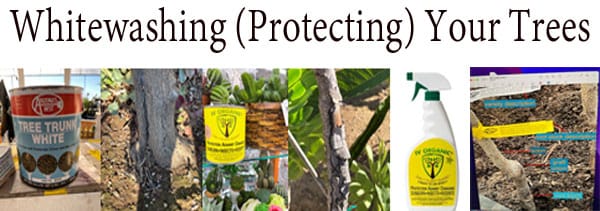
Below are two methods (traditional and Organic) of plant protection that should be considered in your landscape for species that are vulnerable to sunburn. By protecting your trees they will be happier, stronger, and thrive. The first one is called Arizona’s Best Tree Paint, White and it is the traditional method. The second method is IV Organics® 3 in 1 Plant Guard™ and that one is organic.
Traditional Method: Arizona’s Best Tree Paint
Whitewashing of trees has been around for decades and is the old stand by when people think of protecting their trees, they automatically gravitate to products like Arizona’s Best Tree Paint, White. This material is a ready to use vinyl latex paint specially formulated product for a sun protective finish for the use on all types of trees. Latex is a water-based paint and is for interior use only. Oil-based paints are not suitable for use as tree trunk paints because they can harm the bark and wood. Exterior latex paints contain antimicrobial ingredients that may harm trees in the long run. With Arizona’s Best Tree Paint, White you can apply the paint with a brush, spray, with a sponge, cloth or even a car wash mitt or roller. When applying via a spray method it usually results in a thinner coat of paint on the trees, so going over the area again if desired should result in more thorough coverage. Use paint full strength for maximum protection. Sometimes, depending on the situation, you may need to thin the product with 1/2 pint of water per gallon of paint. If thinning is desired a second coat may need to be applied after the first coat is dry. When done, simply clean the brush and tools with soap and warm water.
DIY whitewash recipe: Mix white interior (not exterior) latex paint 1:1 with water and brush it onto clean, dry trunks and any bark newly exposed to sun. Interior water-based paint is safer for trees than oil- or exterior paints. (UC IPM; UC ANR)
Arizona’s Best Tree Paint, White is formulated to help protect your trees from the sun’s UV rays. This non-toxic tree-trunk coating is ideal for use on citrus and other thin-bark trees. Below are some tips to consider:
- Do not apply when air or surface temperatures is below 50 degrees f. or if rain is expected within 24 hours.
- This product is not intended for the use as a protection against bark boring insects or bark fungi. However, applying this product makes your trees less susceptible to borers or fungi because it helps protect the tree from sunburn and sunburnt, cracked, and injured areas on the trunk are entryways for such organisms.
- Be sure to wear protective clothing, use an approved respirator, and eye protection when spraying product.
- Tree Trunk White contains crystalline silica and titanium dioxide, avoid breathing in fumes when spraying.
- Before spraying, make sure the sprayer you use is in good working order and no other previous chemicals were used in that sprayer.
- Before spraying product, I recommend run the paint through cheese cloth to get any large clods out so it will not clog the sprayer. As you are spraying on exposed areas you are also shaking the spray bottle so the water and paint does not separate. This method is convenient especially when doing a large area. Spraying with Tree Trunk -White is only intended to be applied on the wood not the foliage.
If you prefer to be all organic, the 3-in-1 Plant Guard™ by IV Organic has ready to use spray that offers a convenient and effective solution to treat your plants as well. This product can be applied on the leaves, stems, and wood. A milky white residue may be present which is harmless.
You are not limited to using the traditional way of whitewashing your trees you do have the option of the organic method.
Organic Method: IV Organics 3-in-1 Plant Guard
Latex paint is designed for painting your house and lasts a long time. Your trees keep growing, and the chemicals (preservatives, algaecides, and fungicides) in the paint (especially with exterior paint) could shed off into the soil and could contaminate the area. Interior paint does not have that issue but it is not organic. However, latex paint does trap moisture in your plants that could cause fungus to develop. IV Organic® 3 in 1 Plant Guard™ does not do this.
Many organic orchardists and growers now avoid latex paint and use other organic approaches instead. IV Organic® 3 in 1 Plant Guard™ is a newer, OMRI-listed option that many organic growers now prefer. It helps protect plant material from sunburn, sunscald, insects, and rodents. The all organic main ingredients are OMRI listed and they are essentially different types of oils like: castor, cinnamon, clove, garlic, peppermint, rosemary, and spearmint. These oils are naturally found in plant material and are oftentimes used in other organic or natural insecticides or rodenticides and have natural pest deterring properties. These substances aide in the protection of your plants because the rodents or insects think the oil extracts are distasteful or smell bad to them so they are more likely to avoid them. The inert ingredients are iron oxide, diatomaceous earth, limestone, mica, milk, and silica. The inert ingredients help the two products bond to the plant. Inside the package can are two containers, one is a bag which is a powder of inert ingredients, the other is a vial of oils, you will need to combine both together in the can that is provided then you simply mix both inert and main ingredients together by adding some water and mix up them thoroughly to the consistency of a slurry. The IV Organic® product dries on the plant pores and does not last for an extended period of time unlike latex paint. This product dries on porous, allowing moisture and nutrients to pass through and not holding the moisture coated surfaces compared to latex paints.
For sun protection one coat per year is sufficient and for insects and rodents up to three times per year for best repellent protection. I have personally used this product on a sun burned plum tree that is surrounded by gravel, a cement walkway, and a building, which is a perfect hot microclimate that is very conducive to sun burning. I applied IV Organic® when the plum has no leaves on it (it was dormant, during winter). I dried the area to be treated because it was a little damp from the morning dew. Then I cleaned the area of debris (dust, dirt, bird droppings, and other foreign material). I used an old paint brush to apply the slurry (to me it looked like the consistency of thin oatmeal), it does have the smell of garlic, which is not overpowering. I used the brown colored product to match the color of the trunk. Other colors may be available like green and white. I have discovered that the product lasts about a year as it fades away. There is also a convenient ready to use spray bottle option (IV Organic™ 3 in 1 RTU) where you can spray it on the leaves to help mitigate sun burning before it happens or help prevent more sunburning from occurring. The spray aides your plant to come back easier after a sun burning.
Traditional vs. Organic Whitewash: Quick Comparison
Both methods protect bark from sunburn; here is how they compare at a glance.
| Feature | Traditional (white interior latex / Arizona’s Best) | Organic (IV Organics 3-in-1) |
|---|---|---|
| Base | White interior latex paint | OMRI-listed plant oils + mineral powder |
| Organic? | No | Yes |
| Apply to | Trunk and exposed wood | Leaves, stems, and wood |
| Re-coat | Long-lasting; dilute 1:1 with water for a DIY mix | Once a year for sun; up to 3x/year for pests |
| On the bark | Can trap moisture | Dries porous and breathable |
| Also helps with | Sunburn (and borers indirectly) | Sunburn, plus marketed insect/rodent deterrence |
How to Apply Whitewash (Step by Step)
When applying any of these products I will provide you some helpful practices that should be followed:
- Paint the trunk from the ground to at least 18 inches above ground.
- The south, southwest, and west sides of the trunk need the most protection (because these areas are the hottest and driest).
- Paint should be applied to all sides of the trunk including the lower (underside) surfaces. Pay close attention to limbs having narrow crotch angles, existing injuries, and graft bud unions because they need protection too.
- When applying, the surface must be clean and dry. Any loose debris should be removed.
- Before application make sure you stir and shake very well.
- It is best to apply any type of whitewash or plant protection before the warm months of the year for maximum effectiveness for sunburn (UC ANR).
Treating a Tree That’s Already Sunburned
If you already have a tree that has sunburn, with cracking areas in the trunk or branch, and want to protect the integrity of the plant so sun burning does not get worse and to possibly help prevent borers or fungus from entering the site that will further compound the problem, this is what you should do. You will need to clean out the area with a pocket knife to healthy tissue, let it dry out, then paint the affected area with interior latex paint (Tree Trunk Paint- White) and paint it on liberally especially inside the grooves and the southwest or west side of the problem area and surrounding areas. Alternatively, you do have the option of using the organic solution- IV Organic® 3 in 1 Plant Guard™.
Please note, before attempting to treat for already occurred sunburn I would recommend to contact a certified arborist to come to the site and examine the issue to be sure it is actually sunburn because other issues could mimic what sunburn looks like which may require a different way or treatment. Alternatively, if feasible and practical you can bring in a fresh sample of the issue sealed in a bag to your favorite Green Thumb Nursery and have one of our nursery professionals examine the problem so we can help you with the issue you may be experiencing. It is highly advised to read, follow, and understand the label directions on the product(s) you are using before applying any of these substances.
Whether you use an organic approach to protect your plants or the old standard. Both approaches are effective and will aide in preserving your favorite trees. Your favorite Green Thumb Nursery may have both products for your needs. Be sure to call ahead to make sure the specific product you need is available.
Sources:
Do you like what you see? Sign up for our weekly newsletter to get content like this every week!
Whitewashing Trees: FAQs
Why are tree trunks painted white?
Tree trunks are painted white to protect the bark from sunburn. The white coating reflects sunlight so the trunk doesn’t overheat on the sunny southwest side and then crack as it cools at night. Those cracks are entry points for wood-boring insects and rot, so reflecting the sun keeps the tree healthier. It’s most important for young, thin-barked, or recently pruned trees.
How do you make whitewash for trees?
Make tree whitewash by mixing white interior latex paint 1:1 with water, then brushing it onto a clean, dry trunk. Use interior (not exterior) water-based paint, it’s safer for the bark than oil- or exterior paints, which contain additives that can harm trees. One diluted coat before summer is usually enough for sun protection.
Where can I buy tree whitewash, and what product do you use?
You can use any ordinary white interior latex paint diluted with water, or a ready-made tree paint. I use two products: Arizona’s Best Tree Paint, White (the traditional vinyl-latex option) and, for an organic approach, IV Organics 3-in-1 Plant Guard. Your local Green Thumb Nursery often carries both, call ahead to confirm the one you need is in stock.
Can you paint tree trunks, and is it safe?
Yes, painting tree trunks white is safe and is a standard orchard practice, as long as you use interior water-based latex thinned with water (or an organic tree guard). Avoid oil-based and exterior paints: their preservatives and antimicrobial additives can harm the bark and leach into the soil. The diluted white coating simply reflects sunlight and lets the bark breathe.
How do you protect citrus trees from sunburn?
Protect citrus from sunburn by whitewashing the trunk and any newly exposed limbs, because citrus has thin bark and burns easily, especially young trees or ones you’ve just pruned open. Paint the exposed wood with diluted white interior latex (or an organic plant guard) before the hot months, and keep enough canopy to shade the trunk. Here in Southern California, summer sun is the main threat, so apply in spring.
When should you whitewash trees?
Whitewash trees before the warm months, in Southern California that means spring, ahead of summer heat. Apply when the bark is clean and dry and air temperatures are above 50 degrees F with no rain expected for 24 hours. You can stop whitewashing a trunk once the tree’s canopy grows enough to shade it on its own.
Does whitewashing protect trees from borers?
Not directly. Plain white whitewash doesn’t repel wood-boring insects, but by preventing the sunburned, cracked bark that borers and fungi exploit, it removes the damage they rely on to get in. So it protects against borers indirectly, by keeping the bark intact.