

Newsletter Articles
How to Grow and Care for Protea, Pincushion, and Cone Bush
By Richard Flowers, ACCNP, Green Thumb Nursery, Ventura
Did you know that the protea is related to the macadamia? Proteas belong to one of the oldest families of flowering plants on Earth, with a pollen fossil record that reaches back into the age of the dinosaurs, tens of millions of years ago. They are prized in the cut-flower trade for blooms that last for weeks, and their relatives give us everything from pincushions (Leucospermum) to colorful cones (Leucadendron). Best of all, most of these plants thrive on near neglect: low water, low maintenance, and lean soil. In fact, if you give them soil that is too rich, or fertilize them the way you would most garden plants, they will not thrive. Let me introduce you to some of the members of this family, show you how they differ, and explain how to keep them thriving in your own landscape.
What Is a Protea?
A protea is a flowering evergreen shrub in the family Proteaceae, a group of plants native to the Southern Hemisphere and most richly represented in South Africa. The family is ancient and famously diverse, which is exactly why the eighteenth-century botanist who named it borrowed the name of Proteus, the Greek sea god who could change his shape at will. Its members include the macadamia nut, so the next time you enjoy a handful of macadamias you can thank a cousin of the protea.
Whether it is a Protea, a Leucadendron, or a Leucospermum, many people lump them all together and call them “proteas.” They are indeed different plants, but they are closely related, they share the same family, and they ask for very similar care. All of them attract butterflies and hummingbirds, all are native to South Africa, and most of them thrive in our dry, Mediterranean climate here in Southern California. Below I will explain their shared needs in detail, but first let me show you the differences so you can make wiser plant selections.
Meet the Relatives: Protea, Pincushion, and Cone Bush
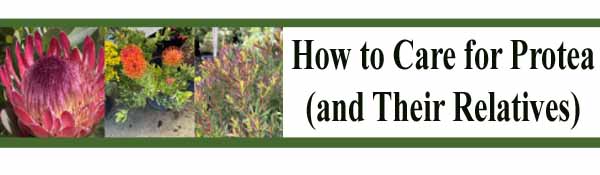
Protea (the sugarbush). Like the pincushion, the protea is most noted for its spectacular flower. The bloom is borne at the branch ends and is made of tight clusters of tubular flowers surrounded by colorful bracts, so the whole display looks like a large, very colorful artichoke. It is a favorite in the florist trade because it holds its color for weeks and keeps its shape even as it fades. The leaves are leathery, often edged in red, and held on thick, heavy stems. Proteas are also called “sugarbushes” because they produce copious nectar that hummingbirds and butterflies adore. The king protea (Protea cynaroides) is the best known of all.
Leucospermum (the pincushion). The pincushion’s most redeeming quality is its blossom, which makes an excellent cut flower and is often used by florists. The flowers are large and rounded, with numerous long, slender, tubular styles rising from the center to form a pinhead or pincushion, which is how the plant got its common name. This exotic-looking bloom usually peaks in winter and early spring, but it can start earlier when conditions are good and can last for months. The foliage is oval, coarse, leathery, and crowded on thick, heavy stems, in shades of grey to grey-green, and the flowers come in reds, yellows, and oranges depending on the variety. Butterflies and hummingbirds adore them.
Leucadendron (the cone bush). Leucadendrons have much smaller flowers than their protea and pincushion cousins. Their main virtue is their colorful modified leaves, called bracts. A bract is a modified leaf that arises below a flower, and novices often mistake these showy bracts for the “flowers” themselves. The bracts are arranged in the form of a cone, which is where the common name cone bush comes from. They appear at the tips of the stems in their glory, usually from late winter into spring, in shades of red, yellow, or orange. Cone bushes are dioecious, meaning male and female flowers are borne on separate plants; most of the plants sold are male, which carry the showier cone-like clusters. Out of color, cone bushes are neat, compact, and almost formal looking, with foliage ranging from multicolored to chocolate, olive, or grey-green. They are attractive year-round, both in the landscape and to pollinators.
Here is how the three compare at a glance.
| Plant | Common name | Signature feature |
|---|---|---|
| Protea | Sugarbush | Large, artichoke-like flower ringed with colorful bracts; the king protea (Protea cynaroides) is the best known |
| Leucospermum | Pincushion | Rounded blooms with many slender styles, like pins in a cushion; a favorite florist cut flower |
| Leucadendron | Cone bush | Grown for colorful cone-like bracts rather than true flowers; dioecious, with male and female plants on separate shrubs |
Soil and the Golden Rule: Go Easy on Phosphorus
In their native habitat, proteas and their relatives grow in poor, sandy, rocky, acidic soils that are low in nutrients. They have specialized proteoid roots, also called cluster roots, that form a dense, absorptive mat near the surface and are an adaptation to phosphorus-poor ground: they release compounds that free up phosphorus the plant could not otherwise reach. Those same roots make proteas forgiving as container plants, since they tolerate erratic or inadequate watering surprisingly well, but they are delicate, so it is best not to disturb them when planting or weeding.
Here is the golden rule, and the single most important thing to understand about these plants: they are intolerant of phosphorus and should generally not be fertilized. Phosphorus is the middle number on a fertilizer label (the first number is nitrogen and the third is potassium). Fertilizers high in phosphorus, and in some cases calcium, can badly damage or even kill a protea. Phosphate toxicity shows up as yellowing leaves that then blacken, followed by the death of the plant. For that reason, avoid gypsum as well unless a soil test shows you truly lack calcium.
If you feel you must feed, use a fertilizer with little or no phosphorus and only low amounts of nitrogen and potassium, applied at about one-eighth to one-quarter of the rate you would use on other plants, and only infrequently. The ideal soil is slightly acidic, around pH 5 to 6.5, and sharply drained. To lower pH, use elemental soil sulfur or iron sulfate, not Epsom salt, which supplies magnesium but does not meaningfully acidify soil. If the leaves turn yellow between the veins (iron chlorosis), a chelated iron foliar spray and soil drench in spring can help green them up.
Here is the whole care routine at a glance.
| Need | What proteas want |
|---|---|
| Light | Full sun, six or more hours a day |
| Soil | Sandy, rocky, fast-draining, slightly acidic (pH about 5 to 6.5), low in nutrients |
| Fertilizer | None to very little, and never high-phosphorus (phosphorus can kill them) |
| Water | Deep but infrequent; mainly during dry spells once established; keep water off the crown |
| Climate | Mediterranean and coastal; most take only light frost |
| Air flow | Space plants so they are not crowded, which helps prevent fungus |
| Pruning | Light, right after flowering; do not cut into old bare wood |
Sun, Water, and Climate
Pincushions, proteas, and cone bushes are native to the Southern Hemisphere, where in the wild they are fire-adapted shrubs of the fynbos and chaparral. They all want full sun, six hours or more, and they are fine in coastal fog. Most are only lightly frost-tolerant once established: many take light frost down to around 28 degrees F, and hardier species tolerate brief dips to roughly 21 degrees F, but prolonged frost or cold, drying wind will cause damage. They also dislike high humidity. Coastal areas are ideal, but they thrive inland too, as long as summers are warm and winters do not get excessively cold.
Once established, these are genuinely low-water plants. Water young plants regularly for the first year or two to settle them in, then shift to a deep, infrequent soak mainly during dry spells rather than frequent sips. As a general good practice, keep the water away from the crown, which is the point where the main stem meets the soil, and apply it out where the branches and leaves reach. Watering early in the day lets the foliage dry before evening, which helps prevent the leaf and stem fungi that cool, damp nights can bring on. Good air circulation matters for the same reason: give each plant room so it is not touching its neighbors, because these plants do not like to be crowded.
Growing Proteas in Pots
Proteas make excellent container plants, which is a real advantage if your garden soil is heavy. Plant them in a fast-draining mix such as a cactus or succulent blend amended with perlite, pumice, or scoria, and do not let the pot go completely dry between waterings. Adequate drainage holes are critical, and you should not use a saucer under the pot, since standing water is one of the few things that will quickly kill a protea. When you plant, whether in a pot or in the ground, slide the root ball out of its nursery container and set it gently into the hole without touching or teasing apart the roots. If your garden soil is clay or drains poorly, amend it heavily with pumice, agricultural-grade gravel, or cactus mix, and plant on a mound or slope for extra drainage. A layer of mulch is valuable because it cuts water loss, improves soil structure and drainage, and gently feeds acidity back into the soil as it breaks down.
How to Prune Proteas
Proteas need very little pruning, and the best time to do it is right after the plant finishes flowering. Keep it light. The most important rule is this: most proteas will not resprout from old, bare wood, so never cut back into a leafless stem. Only cut down to a point where you can still see green leaves, because a new shoot can break only from a living leaf bud. Cutting into bare wood usually kills the stem rather than forcing new growth. A handful of South African species are natural resprouters that can be cut hard to the base, but unless you know you have one of those, treat your plant as one that cannot be cut back severely.
The good news is that harvesting the flowers does most of your pruning for you. When you cut a protea or pincushion bloom for a vase, cut the stem as long as you can while leaving plenty of foliage on the part of the stem that stays on the plant. That single cut shapes the shrub, encourages branching, and gives you a long-lasting cut flower, all at once. Avoid hard-pruning mature, established plants, which can damage them permanently.
How to Propagate Proteas from Seed and Cuttings
Proteas can be grown from seed or from cuttings, though neither is quick. Be patient: these are not plants you rush.
From seed. Protea seed germinates slowly and unevenly, and fresh seed gives the best results. Sowing is best timed for the season when days are warm but nights are turning cool. Because these plants evolved in fire-prone habitats, their germination responds to the chemicals in smoke; treating seed with smoke or soaking it in smoke water significantly improves the germination of many members of the Proteaceae. Sow into a fast-draining, low-nutrient mix, keep it lightly moist, and expect uneven results over several weeks to months.
From cuttings. Most named varieties are grown from cuttings rather than seed, because cuttings come true to the parent plant while seedlings vary. Take semi-hardwood tip cuttings, about four inches long, in early autumn. Strip the lower leaves, dip the base in rooting hormone, and set the cuttings in a sharp, free-draining sandy medium with bottom heat and gentle mist or humidity. Under good conditions the cuttings will usually root within about six to eight weeks.
Companion Plants and Garden Use
Cone bush, pincushion, and protea look wonderful planted with other Australian, South African, and Mediterranean plants such as aloe, coast rosemary, flax, ornamental grasses, kangaroo paw, lion’s tail, tea tree, acacia, bottlebrush, South African bulbs, and grevillea. Because all of these share a love of sun, lean soil, and little water, they grow harmoniously together to create a low-maintenance, water-thrifty, pollinator paradise.
Frequently Asked Questions
How do you care for a protea?
Give proteas full sun (six or more hours), fast-draining acidic soil, and good air circulation. Do not feed them a high-phosphorus fertilizer, and water deeply but infrequently, mainly during dry spells once the plant is established. Keep water off the crown and prune only lightly, right after flowering.
What soil do proteas like?
Proteas want sandy or rocky, fast-draining, slightly acidic soil (a pH of about 5 to 6.5) that is low in nutrients. Rich, heavy, or poorly drained soil is a problem; if that is what you have, grow proteas in a container of cactus mix or plant on a well-amended mound.
Can you fertilize proteas?
Very little, if at all. Proteas are sensitive to phosphorus, and a high-phosphorus fertilizer can damage or kill them. If you feel you must feed, use a product with little or no phosphorus and only low nitrogen and potassium, at about one-eighth to one-quarter of the normal rate.
Do proteas need full sun?
Yes. Proteas and their relatives need full sun, six or more hours a day, to flower well and stay healthy. They tolerate coastal fog but will grow weak and bloom poorly in shade.
Are proteas frost tolerant?
Most proteas are only lightly frost-tolerant once established. Many take light frost down to around 28 degrees F, and hardier species can handle brief dips to roughly 21 degrees F, but prolonged frost or cold, drying wind will damage them. In cold-winter areas, choose a hardy variety or grow proteas in a container you can protect.
How do you propagate proteas?
Proteas grow from seed or from cuttings. Seed germinates slowly and unevenly, and treating it with smoke or smoke water improves germination because these plants evolved with fire. For cuttings, take semi-hardwood tip cuttings about four inches long in early autumn, dip them in rooting hormone, and root them in a sharp, free-draining mix with bottom heat; they usually root in six to eight weeks. Named varieties are grown from cuttings so they stay true to type.
How do you prune proteas?
Prune lightly right after flowering. Only cut back to where you can still see green leaves, because most proteas will not resprout from old bare wood. Cutting the flowers for a vase, leaving foliage on the stem below the cut, does most of the shaping for you. Avoid hard-pruning mature plants, which can damage them permanently.
Sources
- Cluster roots and phosphorus nutrition in Proteaceae (peer-reviewed)
- Botanic Gardens of Sydney, Growing Proteas
- Australian Native Plants Society, the Proteaceae family
- Australian Native Plants Society, smoke germination
- Cambridge University Botanic Garden, Leucadendron
- Oregon State University Extension, how to acidify soil
- Pacific Horticulture, growing proteas in California
- Proteaflora, establishing your new protea (frost tolerance)
I hope these tips help you succeed with these outstanding and unique plants. When you are ready to start, stop by your favorite Green Thumb Nursery location, where our staff can help you choose a protea and the right fast-draining, low-phosphorus potting mix to go with it.
Do you like what you see? Sign up for our weekly newsletter to get content like this every week!
Sign up for the Green Thumb Nursery newsletter