

Newsletter Articles
Dwarf Southern Magnolia: A Compact Evergreen Tree
Written by Richard Flowers, ACCNP
The dwarf southern magnolia, best known by the cultivar Magnolia grandiflora ‘Little Gem’, is a compact evergreen tree that stays around 15 to 20 feet tall and 7 to 12 feet wide, which is roughly a quarter the size of a full southern magnolia. It keeps glossy green leaves with bronze undersides all year and produces large, fragrant white flowers, and it starts blooming while young. That small size makes it one of the best evergreen flowering trees for a small Southern California yard, as a screen, or in a large container. The one thing to know going in: unlike many SoCal favorites, it is not a drought-tolerant plant, so it needs regular water and rich, slightly acidic, well-drained soil.
Quick answer: Dwarf southern magnolia (‘Little Gem’) is a compact evergreen tree, about 15 to 20 feet tall and 7 to 12 feet wide, with large fragrant white flowers from late spring into summer. Give it full sun to part shade, rich and acidic well-drained soil, and regular water; it is not drought tolerant. It suits small yards, screens, and large containers. Note that it is an ornamental here, not a California native, and it drops leaves year-round.
| Attribute | Detail |
|---|---|
| Botanical name | Magnolia grandiflora ‘Little Gem’ |
| Type | Evergreen flowering tree (dwarf cultivar) |
| Mature size | About 15 to 20 feet tall, 7 to 12 feet wide |
| Flowers | Large fragrant white, about 4 inches, late spring into summer |
| Sun | Full sun to part shade |
| Water | Moderate and regular; not drought tolerant |
| Soil | Rich, acidic (pH about 5.5 to 6.5), well-drained |
| Growth rate | Slow |
| Native to | Southeastern US (an ornamental in California) |
What Is a Dwarf Southern Magnolia?
A dwarf southern magnolia is a compact cultivar of the southern magnolia (Magnolia grandiflora). The most popular one is ‘Little Gem’, which North Carolina State Extension describes as a much smaller, slower-growing version of the species, growing as a compact, upright, multi-stemmed shrub or small tree that holds its leaves year-round.[1] It is worth being clear up front that the southern magnolia is not a California native; it comes from the southeastern United States, roughly Maryland south to Florida and west to Texas, so here it is a landscape ornamental rather than a native plant.[2] A couple of other compact cultivars, ‘Teddy Bear’ and ‘Kay Parris’, stay similarly small if you come across them.[3]
Flowers, Size, and Why to Plant One
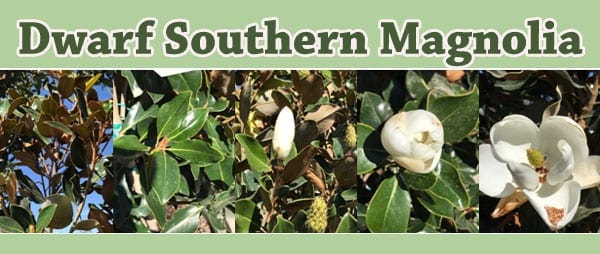
The whole appeal is the size. A full southern magnolia is a giant, reaching 60 to 80 feet tall and 30 to 40 feet wide.[2] ‘Little Gem’ instead stays around 15 to 20 feet tall and only about 7 to 12 feet wide, which is why it fits a small yard where the species never could.[4] Despite the smaller frame it still gives you the classic magnolia show: large, fragrant white flowers about 4 inches across, and it blooms at a young age over a long season from late spring into summer.[1] The evergreen leaves are glossy green on top with a handsome bronze, rusty-brown underside, so the tree looks furnished all year.[1] It works as a small-yard specimen, a flowering evergreen screen or hedge, or in a large container.[4] For other options, see our guide to SoCal shade trees that keep their leaves all year.
How to Grow and Care for a Dwarf Southern Magnolia
Plant it in full sun to part shade.[1] The biggest care point for a Southern California gardener is water: this is not a drought-tolerant tree. It grows best in moist, organically rich, well-drained soil and is specifically described as intolerant of soil extremes, whether dry or soggy,[1] and Cal Poly rates it as a medium-water-use tree,[5] so plan to give it regular supplemental irrigation rather than treating it like a low-water native.
Soil matters almost as much. Magnolias prefer rich, acidic, well-drained soil, around pH 5.5 to 6.5.[3] In the neutral-to-alkaline soils common across much of Southern California, magnolias are prone to iron chlorosis, where the leaves turn yellow between still-green veins, worst on the newest growth; amending with organic matter and keeping the soil on the acidic side helps prevent it.[6] Growth is slow, so start with the size of tree you can afford and be patient.[5]
Pros, Cons, and Common Problems
On the plus side, ‘Little Gem’ packs the beauty of a southern magnolia into a small, evergreen, year-round-foliage package that flowers young and fits tight spaces, containers, and screens.[4] The honest drawbacks: it drops thick, slow-to-decompose leaves year-round, which North Carolina State notes can make for high-maintenance cleanup,[1] its roots spread wider than most trees, so give it room away from pavement,[2] and as covered above it wants regular water and acidic soil rather than neglect.
Pests and problems are few. The main insect to watch for is magnolia scale, which university sources list as the most common magnolia pest and which shows up as bumps on twigs with associated leaf yellowing and sooty mold.[2] Do not confuse that with the tree’s normal habit of dropping a flush of older yellow leaves in spring as new growth pushes out, which is natural and not a problem.[3]
Thinking about a dwarf magnolia for your yard? Visit any Green Thumb Nursery location and our certified staff can help you choose a healthy tree and get the soil and watering right from the start. For small spaces, also see our picks for the best plants for a small yard and our low-maintenance shade tree options.
Dwarf Southern Magnolia FAQ
How big does a dwarf southern magnolia get?
A ‘Little Gem’ dwarf southern magnolia grows to about 15 to 20 feet tall and 7 to 12 feet wide, roughly a quarter the size of a full southern magnolia, which reaches 60 to 80 feet.[4]
Is dwarf southern magnolia evergreen?
Yes. It holds its glossy green leaves, which have bronze undersides, all year, though it does drop some older leaves in spring as new growth emerges.[1]
Does a dwarf magnolia need a lot of water?
It needs regular, moderate water and is not drought tolerant. It prefers moist, rich, well-drained soil and does poorly in soil that is either too dry or too soggy, so plan on supplemental irrigation in a Southern California yard.[1]
What is the smallest magnolia tree?
Among southern magnolias, compact cultivars like ‘Little Gem’, ‘Teddy Bear’, and ‘Kay Parris’ are the smallest, all staying around 15 to 20 feet tall rather than the 60 to 80 feet of the full species.[3]
When does a Little Gem magnolia bloom?
‘Little Gem’ blooms young, starting in late spring and continuing sporadically through summer, with large fragrant white flowers about 4 inches across.[4]
Sources
- [1] NC State Extension, Magnolia grandiflora ‘Little Gem’: plants.ces.ncsu.edu
- [2] UF/IFAS, Magnolia grandiflora: Southern Magnolia (ST-371): ask.ifas.ufl.edu
- [3] Clemson Cooperative Extension HGIC, Magnolia: hgic.clemson.edu
- [4] Missouri Botanical Garden Plant Finder, Magnolia grandiflora ‘Little Gem’: missouribotanicalgarden.org
- [5] Cal Poly SelecTree, Magnolia grandiflora ‘Little Gem’: selectree.calpoly.edu
- [6] University of Minnesota Extension, Magnolia Leaves Discolored (Iron Chlorosis): apps.extension.umn.edu
Sign up for the Green Thumb Nursery newsletter for seasonal Southern California gardening tips.