

Newsletter Articles
Star Jasmine (Trachelospermum jasminoides): Care, Cold Hardiness, and Uses
By Richard Flowers, ACCNP, Green Thumb Nursery Ventura
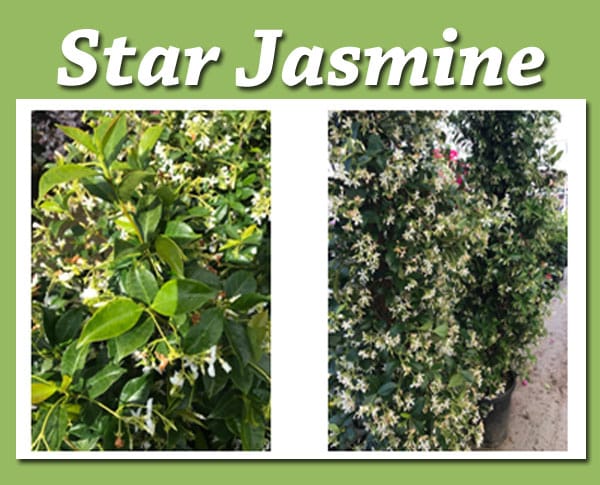
Star jasmine is one of the most adaptable plants I recommend, because it grows so many ways and asks for so little. It can climb big and cover large areas, or you can keep it small and tidy; it works as a shrub, a vine, a ground cover, or a low hedge. This species takes heat, wind, and anything from a little water to regular water, which is why you see it almost everywhere in Southern California. Even when it is not covered in its famously fragrant flowers, it carries glossy dark green leaves year round, with lighter new growth at the tips.
Quick answer: Star jasmine (Trachelospermum jasminoides) is a fragrant, broadleaf-evergreen twining vine in the dogbane family, and it is not a true jasmine. It is drought tolerant once established and cold hardy to about 10 degrees F (USDA zones 8 to 10), with foliage that bronzes in hard freezes and recovers in spring. Grow it as a vine up to about 20 feet or keep it pruned low as a spreading ground cover or hedge; it blooms best in full sun.
What Is Star Jasmine?
Star jasmine is a broadleaf-evergreen twining vine, and despite the name it is not a true jasmine. Its botanical name is a mouthful that sounds a bit like a dinosaur, Trachelospermum jasminoides, and it belongs to the family Apocynaceae, the dogbane family. True jasmines are a different group entirely: they belong to the genus Jasminum in the olive family (Oleaceae). Star jasmine simply shares the sweet fragrance and the common name, which is also why you will sometimes see it sold as Confederate jasmine.
The name itself tells a small story. The genus Trachelospermum comes from the Greek words trachelos, meaning a neck, and sperma, meaning a seed, a reference to the shape of the seeds. The species name jasminoides simply means jasmine-like. Star jasmine is native to eastern and southeastern Asia, reaching into Japan, Korea, southern China, and Vietnam. It is not native to California or the United States, but it has adapted so well to our climate that it thrives here in both hot interior valleys and cooler coastal areas. If you want to see the varieties we stock, you can browse star jasmine in our plant library.
Is Star Jasmine Drought Tolerant?
Yes, star jasmine is drought tolerant once it is established. In its first season, give it regular water while the roots settle in. After that, it withstands occasional to infrequent summer watering, and along the coast it holds up well on very little. That said, it always looks its best with some irrigation, and in hot interior locations you will want to water a bit more generously through the summer heat to keep the foliage lush and the plant flowering.
The practical takeaway is that star jasmine fits both low-water and more traditional gardens. On the coast you can lean on it as a genuinely low-water plant. Inland, treat it as drought tolerant but reward it with the occasional deep soak during heat waves. Either way, plant it in soil with decent drainage, because standing water is far harder on this plant than a dry spell.
Is Star Jasmine Cold Hardy? (Can It Survive a Freeze?)
Yes, star jasmine is cold hardy and can survive a freeze. It grows in USDA zones 8 to 10 and is hardy to about 10 degrees F. In a hard freeze, the leaves have a tendency to bronze, taking on a reddish or coppery cast once temperatures drop below freezing. That color change looks alarming to a lot of gardeners, but it is normal, and the plant greens right back up as the weather warms in spring.
Across most of Southern California, winter cold is simply not a problem for established star jasmine. The lower end of its range, around 10 degrees F, is the cold edge for the plant, so gardeners in the coldest inland pockets should treat it as a zone 8 plant and expect some winter bronzing. If you garden where hard freezes are common, the cultivar ‘Madison’ is often noted as a somewhat hardier selection worth seeking out. For most of our customers, though, a standard star jasmine shrugs off our winters without any special care.
Sun, Size, and Growth Rate
Star jasmine grows in full sun to part shade, and it flowers best in full sun. It will tolerate a surprising amount of shade, which makes it a good choice for difficult, partly shaded spots where you still want an evergreen with a few flowers, but expect fewer blooms the shadier the location. It is a broadleaf evergreen, so it keeps its rich, leathery green leaves all year, with that characteristic bronzing in winter cold.
Growth rate is one of the things people get wrong about this plant. Star jasmine is slow to get going in its first season, then it takes off and grows fast and vigorously once established. As a twining vine left unpruned, it can reach up to about 20 feet, or more in ideal conditions, according to NC State Extension and UF/IFAS. That is a very different plant from the same species kept low: with some tip-pinching and no support, you can manage it as an attractive shrub or ground cover about 2 feet high that spreads up to about 10 feet if you let it.
How to Use Star Jasmine (Vine, Ground Cover, and Hedge)
Star jasmine is one of the most versatile plants you can put in a landscape, and I have seen it used in a remarkable number of ways. It is very effective as a ground cover for large areas, and twining its way up a post or spilling over an arbor is a classic look. If you have a narrow planting space and want a durable vine with support, this plant is often a winner. I once saw an ugly wall completely transformed into a beautiful green curtain by training star jasmine up a trellis against it. When you grow it as a vine, be aware that you may need to tie up the stems to guide the plant in the direction you want it to go.
Pruned lower, star jasmine makes a delightful low hedge, a shrub in raised beds or entry gardens, edging along a walk or drive, an extension of a lawn, or a plant that spills gracefully over walls and under trees. I have even seen it grown in hanging baskets. Because of its strong fragrance, it is reportedly used as a summer patio plant in colder climates and overwintered indoors. For more options in this style, see our guide to the best ground covers for Southern California.
One of my favorite placements is next to fruit trees. The flowers draw bees, especially honeybees, and those visiting honeybees help pollinate nearby fruit trees for a more bountiful crop. Clemson Extension lists it among fragrant vines that support pollinators, and in my own garden I have seen butterflies working the blooms as well. I have even seen hummingbirds pass through a planting of it, though bees and butterflies are the reliable visitors.
How to Plant and Care for Star Jasmine
Plant star jasmine in soil with decent drainage and give it full sun for the most flowers. Dig a hole as deep as the root ball and a little wider, set the plant at the same depth it sat in the pot, and water it in well. For the first season, keep the soil consistently moist so the roots can establish; this is the one time star jasmine genuinely needs regular water. After that, you can ease off to occasional summer watering, deeper and more frequent in hot interior gardens.
Star jasmine thrives and looks its best when it is fed with a general-purpose plant fertilizer twice a year: once before spring growth begins and again after flowering. Prune to shape as needed, and if you are keeping it as a low ground cover or hedge, tip-pinch the stems to encourage dense, spreading growth close to about 2 feet high. When you are training it as a vine, tie the stems to your support to guide them. That is really the whole program. Decent drainage, a couple of feedings, and some light pruning are all this plant asks of you.
Quick Facts
| Attribute | Detail |
|---|---|
| Botanical name | Trachelospermum jasminoides |
| Family | Apocynaceae (dogbane family) |
| Is it a true jasmine? | No. Also called Confederate jasmine. True jasmines are genus Jasminum (family Oleaceae) |
| Mature size (as a vine) | Twining vine to about 20 feet, or more if unpruned |
| Size as a ground cover | Kept about 2 feet high, spreading up to about 10 feet with tip-pinching |
| Growth rate | Fast and vigorous once established (slow the first season) |
| Evergreen | Yes, broadleaf evergreen; foliage bronzes in winter cold |
| Sun | Full sun to part shade; most flowers in full sun |
| Water / drought tolerance | Drought tolerant once established; looks best with occasional summer water |
| USDA zones / cold hardiness | USDA 8 to 10; hardy to about 10°F; recovers after a hard freeze |
| Bloom | Fragrant white pinwheel or star-shaped flowers, late spring to early summer |
| Uses | Vine (arbor, trellis, post), large-area ground cover, low hedge, spilling over walls, hanging basket |
Star Jasmine FAQ
Is star jasmine drought tolerant?
Yes. Once established it tolerates occasional to infrequent summer watering and is considered drought tolerant, though it looks its best with some irrigation in hot interior areas.
Is star jasmine cold hardy, and can it survive a freeze?
Yes. It is hardy to about 10 degrees F (USDA zones 8 to 10) and survives frost. The leaves may bronze in a hard freeze, but the plant recovers once temperatures warm in spring.
How fast does star jasmine grow?
It is slow to establish the first season, then grows fast and vigorously, reaching about 20 feet as a vine if left unpruned.
Does star jasmine grow in shade?
It grows in part shade and is a good choice for difficult, partly shaded spots, but it flowers best in full sun and blooms less in deep shade.
Is star jasmine evergreen?
Yes. It is a broadleaf evergreen with glossy dark-green leaves year-round; the foliage can turn bronze in winter cold and greens back up in spring.
Is star jasmine a true jasmine?
No. Star jasmine (Trachelospermum jasminoides) is in the dogbane family (Apocynaceae). True jasmines belong to the genus Jasminum in the olive family (Oleaceae); star jasmine just shares the fragrance and the common name.
How tall does star jasmine get?
As a twining vine it can reach about 20 feet or more. Kept pruned and tip-pinched it stays around 2 feet high as a ground cover and can spread up to about 10 feet.
Sources
- NC State Extension, Trachelospermum jasminoides
- Clemson HGIC, Vine Selections for Landscaping
- UF/IFAS Gardening Solutions, Star Jasmine
- Wikipedia, Trachelospermum jasminoides
Right now, star jasmine is gloriously in bloom. Your favorite Green Thumb Nursery carries a wide selection of these dependable, easy-care, fast-growing plants year round, whether in bloom or green. We stock plants already trained up on a stake for vining, bush types that are not staked for ground cover and hedge use, and for covering large areas we even offer dirt flats of star jasmine. Stop by your nearest Green Thumb Nursery location to see what is in bloom.
Do you like what you see? Sign up for our weekly newsletter to get content like this every week! CLICK HERE TO SIGN UP!