
Newsletter Articles
Lavender Star Flower (Grewia occidentalis): Care and Growing Guide
By Richard Flowers, ACCNP, Green Thumb Nursery, Ventura
Just the other day a neighbor walked me over to a plant in his garden he could not name: a sprawling, scrambling shrub that had covered a 10-foot span so densely it screened his yard from the road. I recognized it right away as the lavender star flower, and he wanted to know everything about it. If you have seen this plant, admired its little starry lavender blooms, and wondered whether it is a vine, a shrub, or a tree (and how to grow it), here is the full picture.
Quick answer: The lavender star flower (Grewia occidentalis) is a fast-growing South African shrub covered in 1-inch, star-shaped lavender flowers with bright yellow centers. It is naturally a sprawling shrub about 8 to 10 feet tall and wide, but you can train it into a small tree, an espalier along a wall or fence, a clipped hedge, or a groundcover. It wants full sun and fast-draining soil, stays evergreen in mild Southern California gardens, tolerates light frost and some drought once established, and its flowers draw butterflies and birds, making it a versatile, low-fuss plant.
What Is the Lavender Star Flower?
The lavender star flower is botanically Grewia occidentalis, named in honor of the English botanist Nehemiah Grew, often called the father of plant anatomy. It is native to southern Africa, where it grows in habitats ranging from evergreen forest and wooded grassland to coastal dunes (TreesSA). That South African heritage is exactly why it does so well here: our Mediterranean climate suits it, just as it suits other South African garden favorites like agapanthus, society garlic, and bird of paradise. In a mild Southern California garden it behaves as an evergreen, though in colder parts of its range it can be semi-deciduous. The plant also goes by the common names crossberry and assegai wood.
Is the Lavender Star Flower a Vine, Shrub, or Tree?
This is the question I get most, because the plant can look like all three. By nature it is a dense, fast-growing, scrambling shrub, not a true vine, and left on its own it reaches roughly 8 to 10 feet tall and wide in the garden (Devil Mountain Nursery). What makes it so useful is how easily it takes to training:
- Small tree: stake and prune up a single or multi-stem trunk for a compact patio tree where space is tight.
- Espalier: because its growth is strong and flat, it looks wonderful trained along a warm fence or wall, which is my favorite way to use it in narrow spaces.
- Hedge or screen: plant them about 4 feet apart and clip to a dense 6 to 10 foot hedge for privacy.
- Groundcover: remove the upright stems and let the low, spreading growth carpet an area.
It can even be kept quite small in a container, and its roots are not aggressive, so it is safe to plant near walkways, patios, and buildings without worrying about lifted pavement.
Lavender Star Flower Blooms and Berries
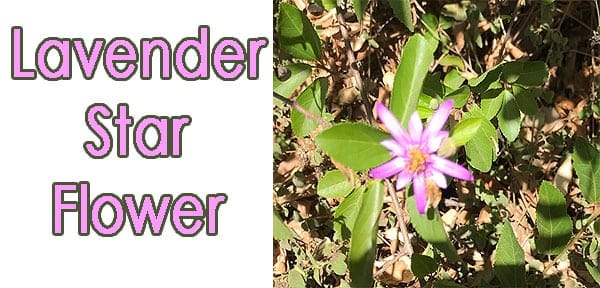
The flowers are the main event: starry, lavender to mauve-pink blossoms about an inch across, each with a tuft of bright yellow stamens in the center (Devil Mountain Nursery). In our mild climate it blooms over a long season, heaviest in the warm months with scattered flowers at other times (Harvest to Table). After the flowers come its signature fruits: distinctive four-lobed, berry-like drupes that ripen reddish-brown to purple and give the plant its “crossberry” nickname. The fruit hangs on for a long time without creating litter, and birds happily eat it (Wikipedia).
How to Grow and Care for Lavender Star Flower
This is a forgiving, low-maintenance plant once it is settled in. Give it full sun for the best growth and heaviest bloom, ideally a west- or south-facing spot, though it will take some light shade. It grows in most soils as long as they drain well. The table below sums up its needs.
| Need | Details |
|---|---|
| Light | Full sun for best bloom; tolerates light shade; west or south exposure |
| Water | Moderate; keep the soil from drying out completely, but it tolerates some drought once established |
| Soil | Most types if fast-draining; if leaves yellow in alkaline soil, apply an iron supplement |
| Size | About 8 to 10 feet tall and wide in the garden; much smaller when trained or pruned |
| Hardiness | About USDA zone 9; evergreen in mild areas and tolerant of light frost |
| Bloom | Starry lavender flowers over a long warm-season show |
| Wildlife | Flowers draw butterflies; birds eat the berries |
Feed it about three times a year with an acid-based fertilizer. One thing to watch for in our alkaline Southern California soils is iron chlorosis, which shows up as yellowing leaves with green veins; an iron supplement corrects it. It is hardy to roughly USDA zone 9 and shrugs off light frost (Harvest to Table), and while it appreciates regular water, it will tolerate some drought once its roots are established.
Pruning and Training
The lavender star flower takes pruning beautifully and can be cut back hard at almost any time of year, which is what makes all those trained forms possible. The best time for a shaping cut is right after a flush of blooms drops: pruning then encourages the next round of flowers and keeps the plant tidy. For a hedge or espalier, trim lightly and often to hold the shape; for a small tree, remove the lower and interior growth to expose a trunk; for a groundcover, keep taking out the upright shoots so the plant stays low and spreading.
Using Lavender Star Flower in Your Landscape
Few plants are this versatile. Use it as a fast privacy screen or hedge, as a flowering espalier on a sunny wall, as a tidy patio tree or container specimen, or as a flowering groundcover on a slope. Because the flowers are rich in nectar, it is a lovely pollinator plant that brings butterflies and other visitors to the garden, and the long-lasting berries feed the birds (TreesSA). For more ways to dress up a bare fence or wall, see our guide to covering a fence with beautiful plants, and if you are leaning toward the groundcover route, our guide to ground covers has more options. As a fellow South African native, it also pairs naturally with bird of paradise. In its homeland, by the way, this plant has a long history of traditional uses, from fruit eaten and brewed into drinks to wood and bark put to practical use, a reminder of how valued it has been for generations.
Frequently Asked Questions
What is a lavender star flower?
The lavender star flower (Grewia occidentalis) is a fast-growing South African shrub grown for its 1-inch, star-shaped lavender flowers with bright yellow centers. It also goes by crossberry and assegai wood, and it is well suited to Southern California’s mild, Mediterranean climate.
Is the lavender star flower a vine, a shrub, or a tree?
It is naturally a sprawling, scrambling shrub, not a true vine, but it is wonderfully easy to train. You can grow it as a small tree, espalier it along a wall or fence, clip it into a hedge, or let it spread as a groundcover, which is why people see it in so many different forms.
How big does the lavender star flower get?
In the garden it reaches about 8 to 10 feet tall and wide if left to grow as a shrub. With pruning and training it can be kept much smaller, whether as a compact patio tree, a flat espalier, or a low groundcover.
How much sun and water does it need?
Give it full sun for the best growth and bloom, though it tolerates light shade. Plant it in fast-draining soil, keep the soil from drying out completely, and once it is established it will tolerate some drought while still flowering best with regular water.
Is the lavender star flower evergreen, and is it frost hardy?
In mild Southern California gardens it stays evergreen, though it can be semi-deciduous in colder areas. It is hardy to about USDA zone 9 and tolerates light frost, which covers most of the Southland.
When does it bloom, and how do I get more flowers?
It blooms over a long warm-season show, with scattered flowers at other times in mild climates. To encourage more blooms and keep it shapely, cut it back right after a flush of flowers drops.
Does it have invasive roots?
No. The lavender star flower does not have an aggressive root system, so you can safely plant it near walkways, patios, and buildings without worrying about damage to hardscape.
Sources
- TreesSA, Grewia occidentalis
- Devil Mountain Nursery, Grewia occidentalis
- Harvest to Table, How to Grow Grewia
- Grewia occidentalis (overview)
The lavender star flower is one of those plants that earns its place in the garden many times over, whether you want a quick privacy screen, a flowering espalier, or a pollinator-friendly groundcover. We usually carry it along with other interesting plants, so stop by your favorite Green Thumb Nursery location (a quick call ahead helps us make sure it is in stock), and our team will help you pick the right spot and form for your yard.
Do you like what you see? Sign up for our weekly gardening newsletter to get content like this every week.