

Newsletter Articles
Do You Still Need to Water Plants When It Rains?
By Richard Flowers, ACCNP, Green Thumb Nursery, Ventura
Short answer: Usually, yes. Rain lies more than you’d think: thick canopies, heavy mulch, roof eaves, and even a light shower can leave the root zone bone dry while the surface looks wet. Before you skip a watering, push a finger or a probe a few inches down and check for yourself.
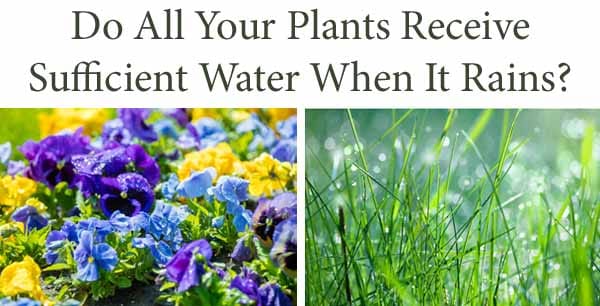
With heavy rain, sometimes enough to cause flooding and mudslides, you need to stop and wonder: do all your plants in your landscape actually receive a sufficient amount of water? Just because it may rain, it doesn’t mean that all your plants will receive enough water. Thunderstorms can be very sporadic when they occur. Some areas receive an abundance of rain while other areas don’t receive any or very little rainfall. It is important to recognize that some plants in your landscape may actually need water even though it is or was raining. Just because the surrounding soil may appear to be moist doesn’t mean your plants are getting enough water.
Why Rain Doesn’t Reach Every Plant
Plants that are interplanted, massed or crowded with other plants can block and deflect rainfall because their canopies can be so thick that water doesn’t actually hit the ground and deliver moisture to the roots (USDA Forest Service). These are the plants you need to pay particular attention to, because they may actually be on the dry side even though it has been raining steadily.
Sometimes plants with large leaves might block the rain from getting into the soil. Because of this, the soil can still be dry, even after a period of heavy rain. Be sure to check those areas thoroughly by moving away the leaves and checking the soil near the plant for adequate moisture. Just because the leaves are wet doesn’t mean the roots get water. Many areas in the landscape are heavily mulched, and at such times the rain that occurs may not be enough to penetrate the thick mulch layer. For that reason, it is wise to move the mulch away or dig through it and the soil, checking both to see if it’s actually getting adequate amounts of moisture.
Mulch, Tree Canopies, and Rain Shadows
Moisture needs to be present long enough to soak through the layers of mulch and reach the soil and plant roots. Think of mulch as a blanket: if you spill some water on the blanket and the blanket is thick enough, you remain dry. You need to apply more water so the liquid soaks through enough to wet your skin. This same concept applies to mulch: research from UC ANR notes that a mulch layer can intercept about half of a light (0.2-inch) rain before it ever reaches the soil. Another area of concern is plants under the canopy of trees or shrubs. Think of the trees as umbrellas: when you stand under the canopy of dense trees, you remain more or less dry. A dense tree canopy intercepts a large share of light rainfall for the same reason (USDA Forest Service). With that being said, the soil underneath those trees, out toward the drip line, where the feeder roots are, remains dry; these areas should not be forgotten.
Certain areas of your landscape may have a rain shadow or microclimate due to the terrain, buildings, structures, shade cloth, canopy, or sheltered areas, where these spots are drier or the water is reduced because it is deflected by the covering. These drier areas should not be ignored. Potted plants underneath the eaves or overhangs do not get the influence of rainwater; even though the surrounding areas are moist, these protected areas need water.
Containers, Porous Pots, Houseplants, and Hanging Baskets
The type of material a landscaping pot is made out of matters, for example, clay can be very porous and absorb moisture very quickly. These pots may need to be checked to see if they need additional water during a rainstorm. Plants in containers, especially if they are crowded with lots of other plants, have leaves and other plant material that block the rain from reaching the soil. All of the leafy foliage covers the soil surface, meaning no rain really reaches the roots. And the bigger and more mature the plants, the more this will be the case. In this situation it is wise to water by hand using a watering wand and target the water directly at the roots, something the rain does not do efficiently. Most containerized soils need to be rehydrated after the initial watering so the entire soil from top to bottom is uniformly moist (UC ANR).
Before and after watering, I like to do a finger test to check to see if the soil is actually wet. The top of the soil may appear to be moist, but what is down below is what matters. So don’t be fooled by rain! If you think it’s rained and you don’t need to water a container, you’re probably wrong. Remember, you do not want to sprinkle the leaves; instead you want to water at the root of the plant.
House plants and interior plants need water even when it’s raining. The same is true for hanging plants. Hanging baskets usually dry out faster than other plants, so make sure to double check those. Many times a rainstorm is accompanied by strong winds that can dry out plants even during the rain, and in that situation watering may still need to be put in place. Likewise, when wind is accompanied by rain, the rain can blow sideways, missing the desired plants entirely. Then again, you may have so much rain and runoff that the plants actually do not receive water at the root zone, resulting in a dry plant.
Clay Soil: Why a Hard Rain Runs Off
After a prolonged period of very little or no rain, clay soil can become rock hard and crack. When rain does occur, the water beads and flows off instead of absorbing into the soil where the plant roots are (Utah State University Extension). After the rain subsides the soil is often softer, and you can reapply water; this water penetrates more easily. With that being said, it can sometimes be a good idea to water your garden after a period of rain, while the ground is already soft. This allows the water to penetrate deeper into the soil, so the plant’s roots will find it easier to take up.
How to Check If the Soil Is Actually Wet
Sometimes a light rain or a quick downpour may not provide enough water to soak or penetrate into the ground. You will need to check the moisture in the soil. If you are not sure, feel around the plant and dig down a few inches, a quick finger test from University of Illinois Extension is to push a finger about two inches in; if it comes up dry, it’s time to water. If the soil looks and feels dry, your plants could use a good watering.
Did you know that, as a common rule of thumb, a quarter inch of rain will usually be enough to avoid needing to water your garden for the day? If the rain is less than 1/4 inch, you might need to give it a little water; if it exceeds that amount, you usually don’t need to worry about adding more. (As a longer-term rule, most lawns and beds want about one inch of water per week, minus whatever rain falls, University of Minnesota Extension.) But always check the soil beforehand. There are a couple of ways to measure what the rain actually delivered:
- Set out containers or a rain gauge. Place equal-size containers throughout your garden; after a rainy period, measure each one. This tells you how much water collected in different areas and gives you an average, so you can decide whether the plants there need water. (A simple rain gauge measures rainfall to the hundredth of an inch, per the National Weather Service.)
- Probe the soil. A more accurate method is to use a bamboo stake or screwdriver so you can tell how far the moisture penetrated around your plant roots. The UC Master Gardener Program recommends exactly this: the probe slides easily through moist soil and stops where it turns dry. Insert it halfway down the root ball and use it on all sides of the plant; you want uniform moisture all around. When you pull the probe out and see soil moisture on it, you’re good for now; if not, the plant needs water.
How Much Rain Is Enough, by Soil Type
An inch of rainfall that infiltrates completely will normally travel a few inches deep in clay and clay-loam soils, and several inches to a foot or more in sandy, coarse, rocky soils (University of Minnesota Extension). In compacted clay, a tenth of an inch of rain may sit on the surface and partially evaporate when the sun comes out, or soak in a mere fraction of an inch. Clay absorbs only a fraction of an inch of rainfall per hour, while sandy soils may take in two inches per hour or more (Utah State University Extension).
| Soil type | How fast rain soaks in | How deep 1 inch of water reaches |
|---|---|---|
| Sandy / coarse | About 2 inches per hour or more | Several inches to a foot or more |
| Loam (approx.) | Moderate | Roughly 7-8 inches |
| Clay / compacted | A fraction of an inch per hour | Only a few inches |
What does this mean for how much your plants actually benefit from a storm? It depends on everything from soil type to runoff. In general, a rain of about a tenth to a half inch gives short-term water to lawns, small plants, and bedding plants, with some benefit to shrubs and trees (UC ANR). But it is not enough to meet the needs of trees and larger plants, to refresh the soil’s water reserves, to flush salts from the upper soil, or even to carry lawns and small plants for more than a few days to a week.
The Bottom Line
It is important to monitor the wetness of the soil and irrigate accordingly. It may have rained recently, but the soil may still be dry, and in that case you should add water. Regularly checking soil moisture helps you avoid both under- and overwatering. You cannot always assume that because it rained, your plants have enough water. A plant left too dry (or kept too wet) can slowly slide into decline; if one of yours is already struggling, here is how to revive a dying plant.
I encourage you to visit all areas of your own garden and get familiar and in tune with where the rain falls, how much, and whether or not all your plants are getting sufficient water.
Sources:
- UC ANR
- USDA Forest Service
- UC ANR
- finger test from University of Illinois Extension
- one inch of water per week, minus whatever rain falls
- rain gauge measures rainfall to the hundredth of an inch
- UC Master Gardener Program
- two inches per hour or more
Do you like what you see? Sign up for our weekly newsletter to get content like this every week!
Watering Plants When It Rains: FAQs
Do you still need to water plants if it rains?
Often yes. Rain does not reach every plant: thick canopies, heavy mulch, roof eaves, and dense foliage can block it, and a light shower may not soak in deep enough. Check the soil a few inches down before you decide to skip a watering.
How much rain is enough to water plants?
About a quarter inch of rain is usually enough to skip watering your garden for the day. If less than 1/4 inch falls, your plants may still need a little water, and trees, large shrubs, and container plants often need more.
Is half an inch of rain enough for plants?
A half inch of rain (about 13 mm) gives short-term moisture for lawns, small plants, and bedding plants, but it is not enough for trees, large shrubs, or to refill deeper soil reserves. A millimeter or two of rain is only a light sprinkle that wets the surface and is far less than the tenth to half inch that gives even short-term benefit. Feel the soil a few inches down after the storm to be sure.
Can potted plants be left in the rain?
Potted plants under eaves or crowded with dense foliage often stay dry even in a storm, and porous pots like clay dry out quickly. Water containers by hand at the root zone instead of relying on the rain.
Can rain overwater plants?
It can, especially in pots with poor drainage or compacted clay soil that holds water at the surface. Make sure containers drain freely and feel the soil before adding more water.
Is rain good for plants?
Yes, rain is good for plants when enough of it actually reaches the root zone. A tenth to a half inch of rain gives short-term water to lawns and small plants (UC ANR), but mulch, tree canopies, and roof eaves can block much of it, and pots with poor drainage can stay too wet. After a storm, check the soil a few inches down before deciding whether to water.
How far does 1 inch of rain penetrate the ground?
It depends on the soil. One inch of rain reaches several inches to a foot or more in sandy soil, roughly 7 to 8 inches in loam, and only a few inches in clay (University of Minnesota Extension). Compacted clay may absorb only a fraction of an inch per hour, so much of a hard rain runs off instead of soaking in.
Related: how to check soil moisture with the bamboo stake method.