

Newsletter Articles
Water Sprouts and Suckers on Fruit Trees
By Richard Flowers, ACCNP, Green Thumb Nursery, Ventura
Short answer: Water sprouts are fast, straight shoots that grow upright from the trunk and branches above the graft; suckers grow from the rootstock below the graft. Both steal energy from flowers and fruit, so remove them whenever you see them, cut them off right where they start, just outside the branch collar, and never let anything grow from below the graft union.
It’s Spring! I went out to my garden and was analyzing my Santa Rosa Plum. It was loaded with flower buds, and some were starting to show their glory of white flowers; in a few months the plums will be ready to harvest. I noticed there was an abundance of vigorously growing shoots shooting straight up several feet. These grew differently than the shorter, stubby growth that characterizes flower buds. These tall shoots are called water sprouts, and they need to be removed, they take energy away from flower and fruit production and make the tree look unattractive by altering its shape.
What Are Water Sprouts and Suckers?
Water sprouts are very fast growing, nearly perfectly straight stems, usually growing straight up from the branch. Most home gardeners who have plums, apricots, apples, peaches, and nectarines are familiar with this phenomenon that occurs annually, but many don’t realize that removing water sprouts and suckers whenever you see them is one of the most important, basic care routines for almost any fruit tree. Both types of growth steal nutrients from your tree, which can make the leaves turn yellow and the fruit or flowers scarce or poor quality. Removing them lets the tree focus its energy on flowers and fruit instead (UC IPM).
Here’s the key difference, and it’s worth understanding: a water sprout grows above the graft, so it is genetically the same as your tree’s named variety, it’s just weak, unproductive wood. A sucker grows from the rootstock below the graft union, so it is a different plant entirely. That distinction is exactly why suckers are such a problem, as you’ll see below.
Water sprouts and suckers can show up on any fruit tree, often after a stress or an anomaly: mechanical injury, excessive water, long rainy periods, drought, soil compaction, high-nitrogen fertilizers, heavy pruning, trauma, or damage to the soil or trunk. The growth looks unsightly, can harbor insects and disease, and blocks sunlight and air circulation from the tree’s interior, all of which hurt the plant’s health and fruit quality. That’s why it’s best to remove them sooner rather than later. On a newly planted tree, removing this growth during the first year helps the tree establish faster, because you divert energy from the fast adventitious growth into root growth, which is what a young tree needs.
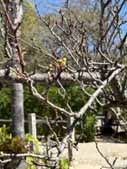
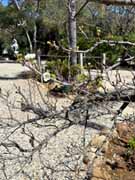
In these photos, notice the short, stubby growth and the flower buds developing. These buds will eventually turn into fruit. This is desirable growth and should not be pruned off.
Why Water Sprouts Are a Problem
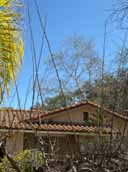
Notice all the tall, vertical growth shooting straight up, these are water sprouts, and they are not fruit-producing wood. These long, gangly shoots produce few if any flowers or fruit. If fruit does form on them, the weak, spindly growth may not support the load, and the branch can break and damage the tree. This vertical growth is also more susceptible to wind damage.
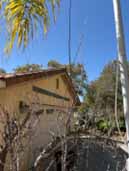
A water sprout is essentially vigorous, unproductive growth, recognized by the excessive amount of growth compared to the rest of the branch. Water sprouts coming off the main scaffold branches are weak and won’t develop into quality fruit-producing wood.
How to Remove Water Sprouts (Summer Pruning)
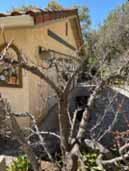
Notice the difference, with all the water sprouts pruned off, the tree is a more manageable size, no longer tall and gangly, and you can actually see the main scaffold branches. More energy now goes toward fruit and flower production instead of fast, weak, vertical growth. In a month or two, new water sprouts will need to be pruned off again; this is also known as summer pruning, and doing it in summer discourages regrowth far better than cutting in the dormant season does (Utah State University Extension).
Remove water sprouts and suckers right where they originate. Cut just outside the branch collar, the slightly swollen ring where the shoot meets the limb, with clean, sharp pruners. Don’t leave a stub, and don’t cut flush into the collar itself, since the collar is what lets the tree seal the wound. On thicker growth, use loppers or a saw (OSU Extension, PNW 400).
What Suckers Are and Why They Come From Below the Graft
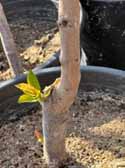
Trunk sucker (arrow pointing to the graft). A sucker is a rapid-growing shoot that comes from below the ground or just below the graft union, and it often looks different from the rest of the tree. Remove any growth originating on the trunk or at the graft line as soon as it appears. If it’s young and tender (as shown here), just pinch it off with your thumb and forefinger every time you see it. If it’s older, use a sharp, clean pruner and cut it out.
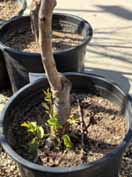
Trunk / basal root suckers (young, tender growth from the soil). Any sucker growth that appears below the graft or bud union should always be removed. The graft is where the rootstock (the below-ground portion) joins the scion (the above-ground, named variety), usually recognizable as a knob or change in bark texture near the base of the trunk, just above the soil. Growth should never be allowed from below this point. Pull very young, tender suckers out of the ground; dig out older ones carefully so you don’t damage the trunk (UC IPM).
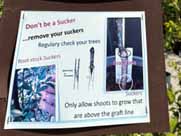
Why be so strict about growth below the graft? Because that growth is the rootstock, not your fruit variety. Left unchecked, rootstock suckers steal energy, make the main tree grow slower and produce less fruit, and can eventually take over or even kill the tree. And here’s the catch: if a rootstock sucker takes over your Santa Rosa Plum, the fruit it produces won’t be a Santa Rosa Plum at all, it will be whatever the rootstock is, which is usually small, sour, or otherwise not worth eating (UC ANR).
Low-Suckering Rootstocks
A couple of select fruit-tree rootstocks for apples and cherries are noted for reduced suckering: Geneva 969 for apple (semi-dwarf) and Maxma 14 for cherry (semi-dwarf). Some of the apple and cherry varieties sold at your favorite Green Thumb Nursery from Dave Wilson Nursery carry a rootstock description tag on the tree.
How to Prevent Water Sprouts and Suckers
A few habits go a long way toward preventing this growth in the first place. When planting a new tree, set it only as deep as it was in the nursery container; if it’s bare root, never bury the graft, keep the graft above the soil line (look for the knob, or the change in bark texture between the upper trunk and the roots). Don’t overwater. Use a slow-release fertilizer rather than a fast-release one, so the tree doesn’t get a sudden surge of growth. When pruning, never remove more than about a third of the plant, and avoid “lollipopping” (topping or shearing it round). And when mulching, don’t pile mulch against the trunk, apply a 3-to-4-inch layer out under the canopy to the drip line, keeping it off the trunk itself.
Sucker-Control Products
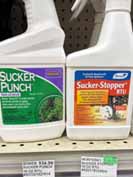
You may want to consider a sucker-control product such as Sucker-Stopper RTU or Sucker Punch to help slow the regrowth of water sprouts and basal suckers on a limited selection of trees. These are plant-growth regulators (NAA), and they are labeled for use only on apples, pears, olives, non-bearing (not in fruit) citrus, and some ornamentals. A few important rules: the label is the law, using one of these on any crop not listed on its label is illegal, even in your own backyard. Apply only to non-bearing trees as directed (NAA can thin or drop fruit on bearing trees), keep it off any leaves and fruit you want to keep, wear gloves, and follow the label’s timing exactly. Any other fruit tree, or a tree whose treatment window has passed, needs to be dealt with by hand. If a tree is struggling or declining, our guide on how to revive a dying plant may help.
I hope you find this information useful. Head over to your favorite Green Thumb Nursery, we are here for all your gardening needs.
Sources:
Do you like what you see? Sign up for our weekly newsletter to get content like this every week!
Water Sprouts and Suckers: FAQs
What are water sprouts on a tree?
Water sprouts are the fast, straight, upright shoots that pop out of a tree’s trunk or main branches, usually after heavy pruning or stress. They grow from above the graft, so they are the same variety as your tree, but they are weak, leafy, unproductive wood that rarely bears good fruit and crowds the canopy. Most should be removed.
Are water sprouts bad for a tree?
In small numbers they won’t kill a healthy tree, but they are best removed. Water sprouts crowd the canopy, shade out fruiting wood, block airflow (which invites disease), and divert energy into growth that won’t produce a good crop. You can keep a few to fill a gap or shade newly exposed bark, but most should go.
Do water sprouts produce fruit?
Rarely, and not well. Because water sprouts are fast, vertical, vegetative growth, they put their energy into leaves and height rather than fruit, and any fruit they do set is usually sparse and poor. If you want to keep one to fill a gap, bend it toward horizontal to calm its vigor and encourage fruiting.
What is the difference between a water sprout and a sucker?
A water sprout is a vigorous, upright shoot that grows from the trunk or branches above the graft, so it is the same variety as your tree, just weak, unproductive wood. A sucker grows from the rootstock below the graft union, so it is a different plant entirely. Both should be removed, but suckers are the bigger problem because they come from the rootstock.
How do you get rid of water sprouts on a fruit tree?
Cut each water sprout off where it starts, just outside the branch collar, with clean, sharp pruners, don’t leave a stub and don’t cut into the collar. Remove them while they are young and soft, and expect to repeat in summer, since new ones appear every year. Summer removal discourages regrowth better than dormant-season pruning.
Why does my fruit tree grow so many water sprouts?
Water sprouts are the tree’s vigorous response to stress or heavy cutting: severe pruning or topping, mechanical injury, overwatering, drought, soil compaction, or high-nitrogen fertilizer. Pruning less drastically, watering properly, and using slow-release fertilizer all help reduce them.
Should you remove suckers from the base of a fruit tree?
Yes, always remove growth from below the graft union. It comes from the rootstock, not your fruit variety, and if it takes over it will produce small, sour, or otherwise undesirable fruit and can weaken or even kill the tree. Pull young suckers out; dig or cut out older ones.
When is the best time to remove water sprouts?
Summer is best. Removing water sprouts in summer discourages regrowth, while cutting them during the dormant season tends to stimulate even more vigorous sprouting the following spring.
Related: where to water, fertilize, and mulch, the drip line.