

Newsletter Articles
Early Spring Flowers in Southern California: What Blooms First
Written by Kelsey W.
Quick answer: In Southern California, the first flowers of spring actually open in December and January, when manzanita, sasanqua camellias, and chaparral currant start the show. Most early spring flowers hit their stride in February and March, and fall is when you plant for them. If you want the earliest possible color, get natives and flowering shrubs in the ground in October or November and let the winter rains do the heavy lifting.
Spring is a volatile time in Southern California when we often experience temperature swings that feel like winter one day and summer the next. Fortunately, there are several beautiful plants that thrive in these early spring conditions and will happily bloom for you while the days are still short and we’re just getting used to the slowly warming temperatures.
Not only does California boast several native plants that will bloom for you early in the year, but there are also some popular species from around the world that grow well in the early spring in Southern California gardens. Sure, there is always something blooming somewhere in Southern California, but the darkest days of winter do slow things down. Let’s talk about the early blooming flowers that will get the springtime color rolling right along.
Which Flower Blooms First in Spring?
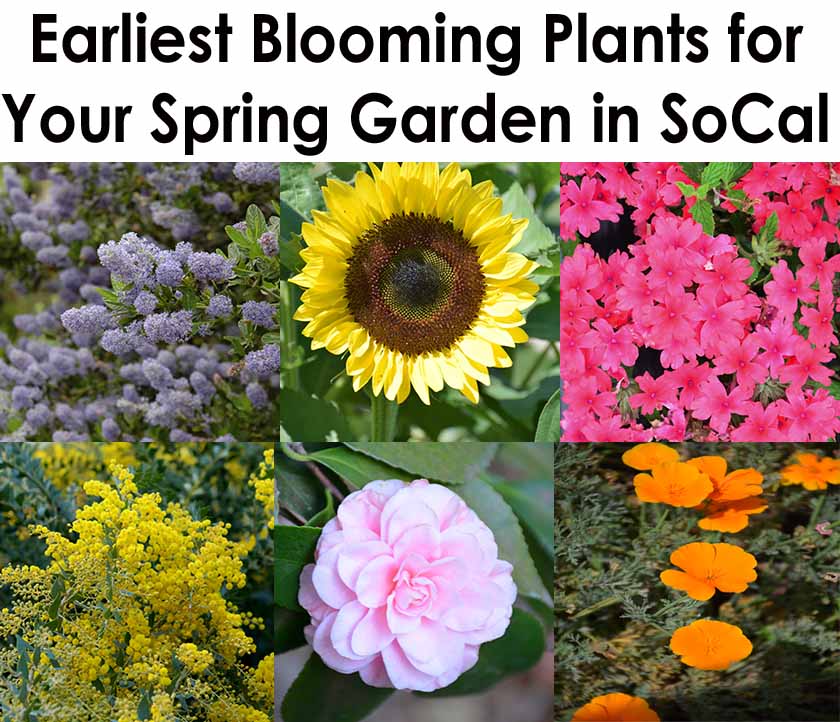
In Southern California, the first flower to bloom in spring is usually manzanita, and it doesn’t even wait for spring to make its entrance. Early cultivars like Austin Griffiths manzanita open their little urn-shaped, pink-and-white flowers in early winter, often by December, according to Calscape. Chaparral currant and sasanqua camellias bloom in that same window, acacias turn gold in January and February, and Ceanothus and California poppies join the party in February.
Technically, sasanqua camellias and chaparral currant start blooming even earlier, back in fall, so the garden is never truly flowerless. Manzanita is simply the first bloom that feels like spring rather than a holdover from autumn.
If that sounds suspiciously early, welcome to gardening in Southern California. Our first flowers of spring show up while most of the country is still scraping ice off the windshield, which is exactly why the planning (and the planting) happens in fall.
A First-Bloom Calendar for Southern California
Want the whole season at a glance? Here’s a cheat sheet to the flowers that bloom in early spring around here, ordered by when each plant typically opens its first flowers. Your microclimate can shift these windows by a few weeks in either direction.
| Plant | Type | First blooms | Where it shines |
|---|---|---|---|
| Sasanqua camellia | Evergreen shrub | October to December | Beds with morning sun, all regions |
| Chaparral currant | Native shrub | November to January | Dry shade, coastal and inland gardens |
| Manzanita (like Austin Griffiths) | Native shrub | December to January | Full sun, low-water native gardens |
| Acacia | Shrub or small tree | January to February | Hot, dry, Mediterranean-style yards |
| White flowering currant | Native shrub | January to February | Coastal and temperate native gardens |
| Arroyo lupine | Native annual | January to April | Coastal and inland wildflower beds |
| Desert sand verbena | Native annual | February to May | Sandy desert and Inland Empire soils |
| Desert sunflower | Native annual | February to May | High desert and xeriscaped yards |
| Japonica camellia | Evergreen shrub | February to April | Shade and part shade, all regions |
| Ceanothus (California lilac) | Native shrub | February to April | Sunny coastal slopes and gardens |
| California poppy | Native wildflower | February to September | Nearly everywhere in SoCal |
| Forsythia | Deciduous shrub | February to March | Cooler inland and foothill pockets |
Bloom windows compiled from Calscape, UC IPM, and NC State Extension plant profiles; see the Sources list at the end of this article.
When Is Early Spring in Southern California?
Early spring in Southern California means February and March. Most of our neighborhoods see nearly frost-free winters, so the bloom season gets rolling in February while gardeners in colder states are still waiting for April. The bloom calendar backs that up: Calscape lists California poppies opening in February, and UC IPM has acacias blooming in January. By the time the calendar officially says spring, our early bloomers are already in full swing, and some of them (looking at you, manzanita) are nearly finished.
So if a planting guide tells you to wait until after the last frost, remember that it probably wasn’t written with SoCal in mind.
Early Blooming Native Flowers for Desert Homes
If you are in one of the drier and hotter areas of Southern California, like the high desert, the Inland Empire, or anywhere that xeriscaping is more popular than lush greenery, you’ll want to choose early-blooming flowers that also love the desert.
Some native plants that will beautify your yard with ease include desert sand verbena and desert sunflowers. Desert sand verbena grows quite well in sandy soil and may have you thinking you have a jasmine tree growing in your yard when the winds pick up its fragrance. According to Calscape, it blooms from roughly February through May, with fragrant pink to lavender flowers that peak as spring warms up.
Desert sunflowers run on a similar schedule, blooming through the winter and spring months, roughly February to May per Calscape. Their cheerful yellow blooms will keep your yard looking lovely until the real desert heat arrives, and potentially a little longer if you’re not too far out in the desert.
Early Blooming Native Flowers for Coastal Homes
For homes closer to the coast, you may want to check out Ceanothus (California lilac) for your early-blooming plants. Despite the common name, the flowers aren’t purple like a true lilac. Calscape describes them as blue to violet-blue, and a mature plant in February is absolutely covered in them (and in very happy bees). Most varieties bloom from late winter into spring and thrive in coastal gardens.
Another terrific flower, and one that loves living at the coast, is the California poppy. You’ll often see these beautiful flowers growing wild along the Pacific Coast Highway, but they grow well just about anywhere in Southern California, even several miles inland.
One of the best parts about planting California poppies, other than the fact that they’re the official state flower, is their wonderfully long season. Calscape lists blooms from February all the way into September, with the biggest show in spring. The trick is timing: sow poppy seeds in fall, right at the start of the rainy season, so the winter rains can sprout and establish them for a February debut.
Arroyo lupine is another wonderfully colorful flower for your coastal home (it will also grow inland, but not too far into the desert areas). Also known as Lupinus succulentus, it sends up spikes of purple-blue flowers starting in winter and continuing well into the spring, per Calscape. Like poppies, it’s happiest sown from seed with the first fall rains.
Early Blooming Flowers for Temperate SoCal Climates
If your home sits somewhere in the middle and isn’t right next to the coast but isn’t in the high desert either, you have quite a few beautiful flowers to choose from for your early spring garden. You can grow virtually all of the plants listed for coastal and desert areas, plus a couple of imports worth an honest conversation.
Forsythia creates a magnificent patch of yellow flowers that looks quite striking because the blooms appear on bare branches before the leaves start to grow. UC IPM lists it as a deciduous shrub that flowers in late winter and early spring. Here’s the honest part, though: forsythia is a shrub for USDA zones 5 through 8, per NC State Extension, and it wants a real winter chill to bloom well. In mild coastal SoCal it often blooms sparsely, so save it for the cooler inland and foothill pockets, where it will reward you properly.
Another brightly blooming shrub, and one that becomes quite colorful as early as January, is the acacia (yes, a lot of early bloomers are yellow!). Most acacia species bloom in January and February, according to UC IPM, and they’re quite drought-tolerant once established, thanks to their Australian roots and their love of our Mediterranean climate. One caveat: a few species, including Acacia dealbata (silver wattle), are rated invasive in California by Cal-IPC, so ask at the nursery for a well-behaved species before you plant one.
The Long Game: Shrubs and Small Trees That Bloom Early
If you have the patience to plant a shrub or small tree and watch it grow over the years, you can choose one that will give you early-season blooms each year without any replanting. One thing worth clearing up: flowering currants are shrubs, not trees, and they’re some of the best early bloomers we grow.
The chaparral currant (Ribes malvaceum) starts blooming in fall and carries its dangling pink flower clusters through winter and into spring, per Calscape. Its cousin the white flowering currant (Ribes indecorum) follows in late winter and early spring with clouds of small white flowers, also per Calscape. Hummingbirds adore both.
And don’t forget manzanita, the winter workhorse we mentioned up top. Common manzanita grows as a large shrub or small tree with gorgeous smooth red bark, per Calscape, and the manzanita flowers on early cultivars like Austin Griffiths open before nearly anything else in the garden.
Another beautiful option for your yard is the camellia, which you can grow as a shrub or small tree depending on how you prune it. Although camellias aren’t native to Southern California (they come from Asia), they grow well in many environments throughout SoCal. The variety matters more than most people realize: Camellia sasanqua blooms from late fall into winter and tolerates more sun, per NC State Extension, while Camellia japonica blooms roughly February through April and prefers shade or part shade, also per NC State Extension. Plant one of each and you can have camellias in bloom from October to April.
Plant Now: Fall Planting Sets Up the Earliest Spring Flowers
Here’s the detail that surprises a lot of new SoCal gardeners: the earliest spring flowers get planted in fall. The UC Master Gardeners recommend fall planting for California natives because the soil is still warm enough for root growth while the fall and winter rains settle plants in long before summer heat arrives. If you’re reading this in October or November, your timing couldn’t be better.
Three ways to put fall to work:
- Plant native shrubs now. Manzanita, Ceanothus, and flowering currants all establish beautifully on winter rains. If you’re building out a native garden, our guide to native flowering plants for your SoCal garden is a good place to start.
- Sow wildflower seed with the first rains. California poppies, arroyo lupine, and most wildflower mixes want to be scattered between October and December so they can sprout with the storms.
- Plant spring bulbs. October is prime bulb season here; see our guide to buying bulbs in October for the full rundown.
Encouraging Plants to Bloom Early
Putting plants into the ground with a natural blooming season in the late winter or early spring is the easiest way to ensure a beautiful and colorful yard as soon as the sun starts giving us more of its light each day, but it’s not your only option. A few care tweaks can nudge the plants you already have.
First, you’ll want to make sure the plants you want to bloom sit in the sunniest place in your yard. Putting your plants in pots that let you chase the sun through the seasons is one option. Planting in a south-facing spot that gets plenty of light is another.
Next, go easy on the nitrogen. When soil is loaded with it, plants happily grow leaves and skip the flowers; Clemson HGIC lists excess nitrogen as one of the most common reasons plants fail to bloom. You don’t want to starve your plants, just keep nitrogen moderate so they put their energy into flowers instead of foliage.
As for winter watering, you might have heard that watering more in winter coaxes earlier blooms. Not in Southern California. Winter is our rainy season and the natural growing season for our native plants, so let the rain do the work. Only water when the rains fail and the soil is dry an inch or two down; per the UC Master Gardeners, overwatering established natives in winter does far more harm than good.
Finally, when your flowers start blooming, keep removing the old, spent blooms. Deadheading redirects the plant’s energy from making seeds into making more flowers, per Penn State Extension, which keeps the show going longer.
Tip on Plant Placement: Although many of the plants discussed here have an area of Southern California that might be considered “best,” those rules aren’t absolutely firm. Sure, California poppies love living along the coast, but you can certainly grow them well inland, too, as long as you give them the right growing conditions.
Early Spring Flower Questions, Answered
Which flower blooms first in spring?
In Southern California gardens, the first flower of the spring cycle is usually manzanita, with early cultivars like Austin Griffiths opening their urn-shaped pink and white flowers as soon as December. Sasanqua camellias and chaparral currant start even earlier, in fall, so a well-planted yard is never without flowers heading into spring.
When do camellias bloom?
It depends on the type. Camellia sasanqua blooms from roughly October through December and handles more sun, while Camellia japonica blooms from about February through April and prefers shade or part shade.
When should I plant California poppy seeds?
Sow California poppy seeds in fall, ideally October through December, right at the start of the rainy season. The winter rains sprout and establish the seedlings, and you’ll see the first orange flowers as early as February.
When is early spring in California?
In Southern California, early spring effectively means February and March. Our nearly frost-free winters let the bloom season start a good two months ahead of colder parts of the country.
What can I plant in April in California?
April is for planting warm-season color and vegetables, things like salvias, zinnias, tomatoes, and peppers. The early spring bloomers in this article get planted the previous fall, so if you missed that window, make a note for October.
What flowers bloom in winter in Southern California?
Manzanita, sasanqua camellias, chaparral currant, and white flowering currant all bloom through the heart of winter here, and acacias join them in late January. A garden planted with these never really has an off-season.
What flowers bloom all year round in California?
No flower truly blooms all twelve months, but repeat bloomers like coneflower, coreopsis, catmint, and bougainvillea come close in our mild climate. We cover the best of them in our guide to long-lasting flowers for your Southern California garden.
Sources
- Calscape: Austin Griffiths Manzanita
- Calscape: Common Manzanita
- Calscape: Hairy Sand Verbena
- Calscape: Hairy Desert Sunflower
- Calscape: Ceanothus (California Lilac)
- Calscape: California Poppy
- Calscape: Arroyo Lupine
- Calscape: Chaparral Currant
- Calscape: White Flowering Currant
- California State Capitol Museum: State Symbols
- UC IPM: Forsythia
- NC State Extension: Forsythia x intermedia
- UC IPM: Acacia
- Cal-IPC: Acacia dealbata (Silver Wattle)
- NC State Extension: Camellia sasanqua
- NC State Extension: Camellia japonica
- UC Master Gardeners: Fall Planting of California Natives
- Clemson HGIC: Why Plants Fail to Flower or Fruit
- Penn State Extension: To Deadhead or Not
Bring Greenery to Your Yard at Green Thumb Nursery
Spring is coming, and it’s time for plants to awaken and start blooming again. If you’re searching for early spring flowers to beautify your garden (or fall plantings to set them up), visit your local Green Thumb Nursery, where you’ll find a wealth of options at all five of our Southern California locations. Greet the spring with a garden filled with lovely, fragrant flowers this year.
Do you like what you see? Sign up for our weekly newsletter to get content like this every week!