

DIY Ideas, Newsletter Articles
How to Display Air Plants: DIY Driftwood and More
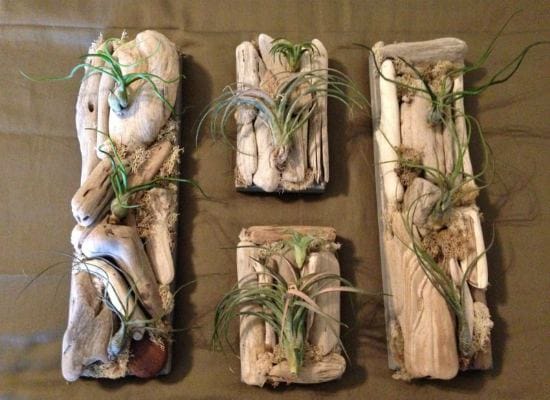
Air plants (Tillandsia) grow without soil and absorb water through their leaves, so you can display them almost anywhere: on driftwood, bark, rocks, or shells, or hung from fishing line. The rule that matters most is airflow: give them good air circulation and let them dry after watering, so skip sealed containers.
Quick answer: To mount an air plant, set its base against driftwood, cork bark, a rock, or a shell and secure it with fishing line, thin nylon-coated wire, or a dab of waterproof glue, leaving the base exposed so it can dry. Many growers prefer to avoid bare copper wire. Keep the finished piece in bright, indirect light with good airflow, and take the plant down to soak or mist it about once a week, letting it dry fully before returning it to the display.
| Question | Answer |
|---|---|
| Do air plants need soil? | No. They are epiphytes that absorb water through their leaves and use roots only to anchor |
| How do you attach them? | With fishing line, thin nylon-coated wire, or a dab of waterproof glue (leave the base exposed) |
| Best surfaces | Driftwood, cork bark, rocks, shells, or an open glass globe |
| What to avoid | Sealed containers, water pooling at the base, and (per many growers) bare copper wire |
| Display ideas | Mounted on driftwood, hung on fishing line, in an open globe, or on a framed board |
| Care in brief | Bright indirect light, soak or mist weekly, and let it dry fully with good airflow |
Why You Can Display Air Plants Without Soil
Air plants are the rare houseplant you can fasten to a piece of wood and call it decor. Clemson Cooperative Extension explains that Tillandsia are epiphytes, plants that grow harmlessly on other plants, that absorb all of their nutrients and moisture from the atmosphere and use their roots only for attachment.[1] University of Illinois Extension puts it the same way: instead of pulling water and nutrients from soil through their roots, air plants take them from the air and rain through their leaves.[2] Because they do not need a pot of soil, you can display them on almost any surface, which is exactly what makes them such fun DIY material.
How to Mount Air Plants on Driftwood (and More)
Mounting an air plant is simple, because you are only anchoring it, not planting it. Clemson notes that air plants can be attached to bark, shells, or rocks, and that they can also be hung on fishing line or thin wire to create a display.[1] A few practical steps make a mount last:
- Pick a surface such as driftwood, cork bark, a rock, or a seashell, and decide where the plant will sit before you attach it.
- Secure the base with fishing line, thin nylon-coated wire, or a small dab of waterproof glue; many growers prefer to avoid bare copper wire.
- Leave the base of the plant exposed rather than burying or fully gluing it, so water can drain and the plant can dry, which Clemson stresses is key to preventing rot.[1]
- Avoid water-soluble glue, and keep any adhesive to a minimum so you do not block the leaves.
Mounting does not change how you care for the plant; for the full routine, see our guide to caring for air plants.
Air Plant Display Ideas
Once you know how to attach them, the options open up. Popular displays include a cluster mounted on a weathered piece of driftwood, air plants hung from fishing line at different heights, a single specimen resting in an open glass globe, or several arranged on a framed board or in seashells. The one thing every display needs is airflow. University of California advises that air plants need ventilation and cannot stay wet or they will rot,[3] and Clemson adds that good air circulation helps the plant dry between waterings and prevents disease.[1] That is why open displays work and sealed, closed containers do not: pick a globe or terrarium that is open on at least one side so the plant can breathe and dry out.
Keeping Mounted Air Plants Healthy
A mounted air plant needs the same simple care as any Tillandsia. Give it bright, indirect light and keep it out of direct sun, which can scorch the leaves.[1] About once a week, take the piece down and water the plant by misting it well or soaking it for 20 to 30 minutes, then shake off the excess, turn it upside down to drain, and let it dry fully before it returns to the display.[1] Good airflow does the rest. For a deeper watering routine, see our guide to air plant hydration, and if you are new to indoor plants, our six easy houseplants to grow.
Want to build a display of your own? Stop by any Green Thumb Nursery and our team can help you pick air plants and the driftwood, globes, or mounts to show them off.
Air Plant Display FAQ
How do you attach air plants to driftwood?
Set the base of the plant against the driftwood and secure it with fishing line, thin nylon-coated wire, or a small dab of waterproof glue, leaving the base exposed so it can dry out. Clemson Extension notes air plants can be attached to bark, shells, or rocks this way.[1]
Do air plants need soil?
No. Air plants are epiphytes that absorb water and nutrients through their leaves and use their roots only to anchor themselves, so they grow with no soil at all.[1]
Can you glue air plants to a surface?
Yes. A small dab of waterproof, non-water-soluble glue on the base works, as long as you leave most of the base exposed so it can dry between waterings. Keeping the plant able to dry is what prevents rot.[1]
What do you mount air plants on?
Common surfaces are driftwood, cork bark, rocks, and seashells, or you can hang them from fishing line. Clemson lists bark, shells, and rocks as good attachment surfaces.[1]
Can air plants go in a closed terrarium?
No. Air plants need good air circulation and must dry out after watering or they will rot, so a sealed, closed terrarium is a poor choice. Use an open container or display instead.[3]
Sources
- [1] Clemson Cooperative Extension HGIC, Air Plants: hgic.clemson.edu
- [2] University of Illinois Extension, Air Plants Grow Well in Terrariums: extension.illinois.edu
- [3] University of California (Under the Solano Sun), Air Plant Aesthetic: ucanr.edu
Sign up for the Green Thumb Nursery newsletter for seasonal Southern California gardening tips.
Beautiful and interesting!
Love to have infro. On your stock.