
Newsletter Articles
Desert Plants in Your Yard
Written by Marge B.
Advantages of Desert Plants
There are advantages to planting desert plants in your yard. Succulent and Cactus do not need a lot of water, and they also require minimal maintenance. Native desert plants add a striking accent to your landscape. Native desert plants have desirable qualities that allow them to thrive in a desert climate. When you add these native plants to your landscape, you can benefit from the beauty and durability that they will add to your garden.
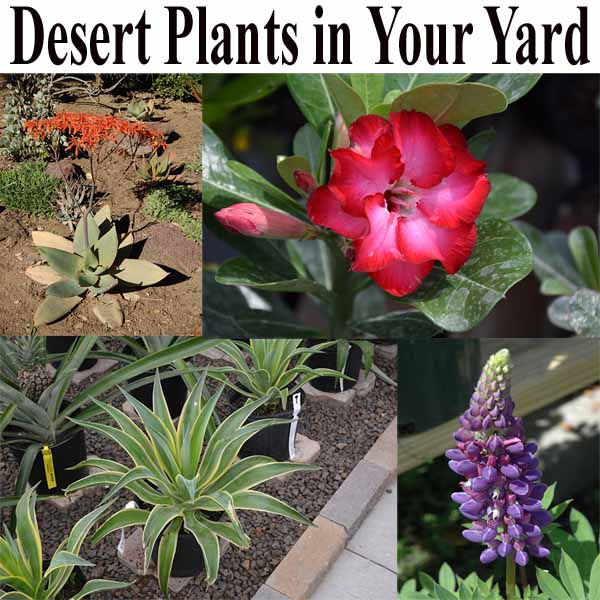
As an ornamental, this plant is usually grown in rock gardens, cactus, and succulent gardens. This plant has large arching leaves that are green with yellow edges. The plant is smaller when grown in containers. Variegated Smooth Agave has bold spikes of yellow cup-shaped flowers in early summer. The succulent sword-like leaves remain blue and green throughout the year. Variegated Smooth Agave is a multi-stemmed evergreen shrub with an upright spreading habit of growth. Its strikingly bold texture can add a dramatic look to your landscape. This shrub will require occasional maintenance and upkeep, and usually looks its best without pruning. Variegated Smooth Agave will grow to be about 3 feet tall at maturity, extending to 10 feet tall, with a spread of 4 feet. It grows at a slow rate, and, under ideal conditions, can live for 30 years. This shrub should only be grown in full sunlight. It prefers dry to average moisture levels. It will often die in standing water. It is drought-tolerant, and an ideal choice for low-water drought-tolerant landscapes. When you want to add desert plants to your landscape design, be sure to talk to the garden experts at any of the Green Thumb Nursery locations, Orange County Garden Center, San Diego Garden Center located in San Marcos, Los Angeles and at Garden Centers located in Canoga Park or Santa Clarita, the Ventura County Garden Center located in Ventura. The advice of the Green Thumb experts can help you select the right cactus and succulents to add to your garden.
The Coral Aloe succulent has broad and flat gray-green leaves that look slightly pink. The Coral Aloe produces orange flower clusters in late winter. Coral Aloe’s has sword-like leaves that remain gray and green with hints of pink. Coral Aloe is an evergreen perennial that grows upright. It has a bold texture, and it can add a dramatic accent to your landscape. Coral Aloe will grow to be about 24 inches tall at maturity, extending to 32 inches tall when the flowers bloom. The plant has a spread of 3 feet. The Coral Aloe grows at a slow rate, and under ideal conditions can live for 40 years. This plant should only be grown in full sunlight. It prefers dry to average moisture levels with very well-drained soil and will die when left in standing water. Coral Aloe will look great in your garden landscape, but it is also a suitable selection for planting in outdoor pots and containers.
Incorporating cacti and succulents into your landscape offers benefits for you. Cacti and succulents are drought tolerant. They have adapted to arid conditions and have evolved mechanisms to store water, making them highly drought tolerant. Cacti and succulents are low-maintenance plants. These plants require little water, infrequent fertilization, and minimal pruning. Cacti and succulents come in a wide assortment of shapes, sizes, and colors. These plants provide a unique accent to your landscape. From spiky and columnar cacti to rosette-shaped succulents, these plants can add texture and visual interest to your garden. Cacti and succulents can be incorporated into various garden styles, from desert-themed landscapes to contemporary designs. They can be used as ground cover, border plants, focal points in rock gardens, or potted plants for patios and balconies. Cacti and succulents provide habitats for pollinators. Their flowers attract bees, butterflies, and hummingbirds.
Double Dark Pink Desert Rose is a striking succulent plant with deep pink double blooms. It is best to grow the Desert Rose in containers that can be moved indoors during the winter months. Double Dark Pink Desert Rose has clusters of hot pink trumpet-shaped flowers with cherry red edges from early spring to early summer. The glossy narrow leaves remain green throughout the winter. Double Dark Pink Desert Rose is a minimal maintenance shrub and should only be pruned after flowering to avoid removing any of the current season’s flowers. The double Dark Pink Desert Rose will grow to be about 6 feet tall at maturity, with a spread of 4 feet. It grows at a slow rate, and under ideal conditions can live for 40 years. This shrub does best in full sun to partial shade. It prefers dry to average moisture levels with very well-drained soil. The plant dies when left in standing water. Parts of the Double Dark Pink Desert Rose are known to be toxic to humans and animals, so care should be used when the plant is in an area around children and pets.
A stunning shrub with thick spikes of eye-catching two-tone lavender-blue and white flowers. This plant will add a visual impact to your garden. It can also be used in borders or in containers. Gallery™ Blue Lupine features bold spikes of blue pea-like flowers with white overtones rising above the foliage from late spring to early summer. The flowers are excellent for cutting. Gallery™ Blue Lupine is a perennial that grows tall and upright. The Gallery™ Blue Lupine will require occasional maintenance. It should be cut back in late fall in preparation for winter. It is known for attracting hummingbirds to your yard. Gallery™ Blue Lupine will grow to be about 18 inches tall at maturity, extending to 24 inches tall with the flowers, with a spread of 16 inches. It grows at a fast rate, and, under ideal conditions, can live for 3 years. This plant does best in full sun to partial shade. It does best in average to evenly moist conditions and will not tolerate standing water. Parts of this plant are known to be toxic to humans and animals, so caution should be exercised in planting them around children and pets. One of the most important advantages of desert plants is that they are easily maintained. Native desert plants require a low amount of water. The qualities of desert plants make them an ideal choice for people with busy lives who do not have extra time to devote to the care of their plants. Another advantage of desert plants inside your home is that they purify the air. They can filter out toxic materials and offer oxygen in return. Native desert plants are incredibly beneficial to your health. Studies have shown that merely looking at plants will improve your mood and will decrease your stress level. Studies have indicated that having desert plants inside your home can have positive effects on you and your family. Studies have also shown that desert plants also provide the home environment with a sense of calmness.
Do you like what you see? Sign up for our weekly newsletter to get content like this every week!