

Newsletter Articles
Best Shade Trees for Southern California: Low-Maintenance, Fast-Growing, and Small-Yard Picks
Written by Kelsey W.
Quick answer: For most Southern California yards, the easiest low-maintenance shade trees are Coast Live Oak and Chinese Pistache (tough, drought-tolerant, and strong-wooded), plus the evergreen ‘Marina’ strawberry tree for coastal gardens. If you want shade fast, plant Brisbane Box (evergreen) or Desert Museum Palo Verde (very low water). For a small yard, Western Redbud and Hollyleaf Cherry both stay well under 30 ft while still casting real shade.
There is nothing quite like stepping into the cool pocket of shade under your own tree on a blazing SoCal afternoon. The trick is choosing a tree that gives you that relief without demanding your whole weekend. Some gorgeous trees drop a relentless carpet of leaves, lift your sidewalk, or need constant pruning, and that is a lot to take on when all you wanted was a shady spot to sit.
The good news is that plenty of beautiful trees are nearly self-sufficient once they settle in. Below are ten dependable shade trees (plus a lovely flowering runner-up) that thrive here, grouped so you can match the right one to your yard. Coastal gardens want salt-tolerant, breeze-loving trees, while inland and Inland Empire yards do best with heat- and drought-adapted picks, so I will flag which is which as we go.
| Tree | Mature size (H x W) | Growth rate | Evergreen or deciduous | Best for |
|---|---|---|---|---|
| Coast Live Oak (Quercus agrifolia) | to ~70 ft x ~70 ft | Moderate | Evergreen | Native; coastal and inland; big iconic shade; very low water once established |
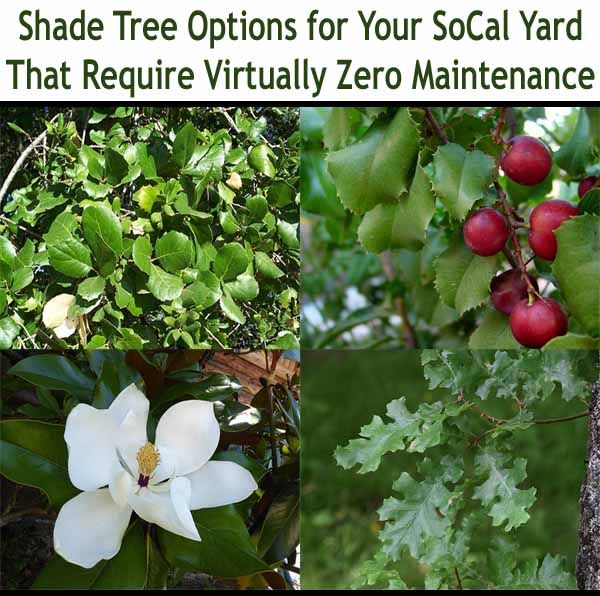
| Hollyleaf Cherry (Prunus ilicifolia) | 15 to 30 ft x ~25 ft | Moderate | Evergreen | Native; small yard; coastal (salt-tolerant); dappled shade; frost-tender young |
| Southern Magnolia (Magnolia grandiflora) | to ~80 ft x ~60 ft (‘Little Gem’ ~20 ft) | Moderate | Evergreen | Large pest-resistant evergreen; needs room plus some leaf cleanup |
| Valley Oak (Quercus lobata) | to ~70 ft x ~50 ft | Fast | Deciduous | Native; inland valleys and Inland Empire; fast big shade, winter sun |
| Chinese Pistache (Pistacia chinensis) | ~40 ft x ~35 ft | Moderate | Deciduous | Tough and low-maintenance; best fall color; strong wood (buy fruitless male) |
| ‘Marina’ Strawberry Tree (Arbutus ‘Marina’) | 25 to 40 ft x ~30 ft | Moderate | Evergreen | Coastal (salt-tolerant); low-litter; year-round flowers; non-invasive |
| Brisbane Box (Lophostemon confertus) | ~50 ft x ~30 ft | Fast | Evergreen | Fast evergreen shade; dense canopy; tough urban tree |
| Desert Museum Palo Verde (Parkinsonia ‘Desert Museum’) | ~25 ft x ~25 ft | Fast | Mostly deciduous | Fast and small; inland and desert; very low water; thornless |
| Western Redbud (Cercis occidentalis) | 10 to 20 ft x 10 to 15 ft | Fast | Deciduous | Native; small yard; spring flowers; low water |
| Australian Willow (Geijera parviflora) | 25 to 35 ft x ~20 ft | Fast | Evergreen | Narrow side yards; evergreen, very low litter; low water |
| Crape Myrtle (Lagerstroemia, mildew-resistant hybrids) | 15 to 25 ft x ~25 ft | Moderate | Deciduous | Small flowering accent; dappled shade; summer bloom plus fall color |
Coast Live Oak (Quercus agrifolia)
The Coast Live Oak is the classic California native evergreen for big, iconic shade, reaching about 70 ft tall and nearly as wide at maturity, with branches that often spread wider than the tree is high. Because it holds its leaves year-round, you get cool shade in every season, and it only sheds heavily when it is severely stressed by drought. It handles full sun to partial shade near the coast and does beautifully inland too. According to SelecTree’s Coast Live Oak profile, it grows at a moderate pace, so it is not the slowpoke many people assume.
Caring for one is refreshingly simple. Keep the roots cool and give it regular water for the first few years while it establishes. After that, as Calscape notes for this native, it wants very little summer water. In fact, overwatering a mature oak invites crown rot and oak root fungus, so resist the urge to pamper it. Give it room away from pavement (its roots have moderate lifting potential), expect a light drop of acorns in fall, and prune only when it is dormant. If you love oaks, you can also compare oak trees in our plant library.
Hollyleaf Cherry (Prunus ilicifolia)
The Hollyleaf Cherry is a small-to-medium evergreen California native, growing 15 to 30 ft tall and around 25 ft wide, which makes it a wonderful fit for a smaller yard. Like the Coast Live Oak, it stays leafy all year, so you get dappled, filtered shade without the fall leaf avalanche of a deciduous tree. It is one of my favorite choices when someone wants real shade but does not have room for a giant.
It is drought-tolerant once established and salt-tolerant, so it performs especially well in coastal gardens. The one thing to watch is cold: young trees are frost-tender, so give them a sheltered spot while they are getting started. It produces small cherries that drop in modest amounts, and while the fruit is edible, the seeds are toxic, so it is good to know if you have curious kids or pets at home.
Southern Magnolia (Magnolia grandiflora)
The Southern Magnolia is a large evergreen prized for its huge white blooms, glossy leaves, and strong resistance to pests and disease. It is not a California native, but it has earned its popularity across SoCal. One thing to be honest about: the full species gets big, to roughly 80 ft tall and 60 ft wide, so it needs real space to spread out.
It is pest-resistant, but it is not litter-free. Those big leathery leaves drop a little year-round, along with spent flowers and seed cones, so plan on occasional raking. The upside is that the leaves are large and easy to scoop, unlike the fiddly little leaves that slip right through a rake. For a small lot, I steer people toward the dwarf cultivar ‘Little Gem’, which tops out near 20 ft and stays tidy. Give your magnolia medium water and prune lightly after it blooms. You can read more on our Southern Magnolia plant-library page.
Valley Oak (Quercus lobata)
The Valley Oak is a deciduous California native and, contrary to what many guides say, it is actually fast-growing, putting on real size quickly on its way to about 70 ft tall and 50 ft wide. This is the correction I most love sharing, because it means you do not have to wait a lifetime for big shade from a native oak. Per SelecTree’s Valley Oak profile, it can add roughly 36 in per year.
Being deciduous is a feature here, not a flaw. It gives you dense summer shade and then drops its leaves to let warm sun through in winter, which is exactly what you want on a cool January afternoon. It is drought-tolerant once established, appreciates deeper soil, and does its best work inland, in the valleys and the Inland Empire, where it grows wild across San Bernardino and Riverside. One local note: Valley Oaks are protected in some areas, so if one flourishes in your yard you may need a permit to remove it later. Young trees need light shaping every few years, easing to about every five years as they mature.
Chinese Pistache (Pistacia chinensis)
The Chinese Pistache is the textbook tough, low-maintenance SoCal shade tree: a deciduous grower to about 40 ft tall and 35 ft wide with moderate speed, low water needs, and famously strong wood that shrugs off wind. It is practically pest-free, has low root-damage potential, and delivers the best orange-red fall color on this whole list. SelecTree’s Chinese Pistache profile backs up both its mature size and its sturdy structure.
My one tip: buy a named male grafted form such as ‘Keith Davey’. Female trees set fruit that drops and reseeds, and the grafted males skip all of that, so you get the gorgeous canopy and color with none of the mess. It is hard to beat for a dependable, hands-off yard tree.
‘Marina’ Strawberry Tree (Arbutus ‘Marina’)
The ‘Marina’ strawberry tree is my top evergreen pick for coastal gardens: a moderate grower, 25 to 40 ft tall and about 30 ft wide, with strong branches and high salt tolerance. It looks good every single day of the year thanks to pink flowers that bloom through much of the season, cinnamon-colored peeling bark, and glossy foliage, all with minimal litter to clean up.
It is a sterile hybrid, which is a quiet but important perk. Because it does not reseed, it stays put and is not invasive, so you get all the beauty with none of the worry. Give it medium water and a sunny spot and it will reward you year-round.
Brisbane Box (Lophostemon confertus)
The Brisbane Box is the answer when someone asks for fast, evergreen shade. It grows quickly, around 36 in per year, to about 50 ft tall and 30 ft wide, with a dense, glossy canopy that fills in fast and stays green all year. It also sports handsome peeling bark and tolerates pollution well, which makes it a reliable tough urban tree.
Maintenance is minimal once it is going. The main thing to plan for is placement: give it at least 5 ft from pavement, since its roots have moderate lifting potential. Set it in the right spot and it is one of the quickest routes to a genuinely shady yard.
Desert Museum Palo Verde (Parkinsonia ‘Desert Museum’)
The Desert Museum Palo Verde is the fast, small, very low-water pick for inland and desert gardens, reaching about 25 ft tall and wide while adding roughly 36 in per year. It casts filtered, light shade (so you can still grow things beneath it) and lights up with a long season of bright yellow blooms. For an Inland Empire yard that bakes in summer, it is a dream.
It is a thornless sterile hybrid, which solves the two usual palo verde complaints in one tree: no spines to snag you and no reseeding, so it stays well-behaved and non-invasive. It has low root-damage potential too, making it an easy neighbor to patios and paths.
Western Redbud (Cercis occidentalis)
The Western Redbud is the best small native on this list, a deciduous California native that stays 10 to 20 ft tall and 10 to 15 ft wide and grows fast for its size. In spring it erupts in magenta flowers, then finishes the year with warm fall color, so it earns its keep as both shade and showpiece. Calscape’s Western Redbud profile confirms its compact size, native range, and low water needs.
Because it stays small, it fits neatly under power lines and close to a patio without overwhelming the space. It is low water overall, though inland trees appreciate a few summer drinks. If you want a small flowering shade tree, Crape Myrtle (Lagerstroemia) is another lovely option in the 15 to 25 ft range with summer bloom and fall color and the same dappled shade; just choose a mildew-resistant hybrid like ‘Natchez’, ‘Muskogee’, or ‘Tuscarora’, since older L. indica types tend to get powdery mildew.
Australian Willow (Geijera parviflora)
The Australian Willow gives you that graceful, weeping willow look on a fraction of the water, as an evergreen that reaches 25 to 35 ft tall and only about 20 ft wide. That narrow footprint is its superpower, making it ideal for tighter side yards and parkways where a wide canopy would be a problem. It is evergreen, so the shade never takes a season off.
It is wonderfully tidy, with very low litter and low root-damage potential, and it only needs medium water once established. If you have a slim space that still deserves some shade and softness, this is the tree I reach for.
Trees to Avoid if You Want Low Maintenance
A few fast growers come with headaches that undo the whole point of a low-maintenance yard, so I steer clients away from them. Tipu trees grow quickly but lift sidewalks and rain down sticky psyllid honeydew that coats patios and cars. Fruitless mulberry has aggressive roots and throws off high-allergy pollen. Blue gum eucalyptus and Brazilian pepper are invasive, brittle, and messy, and the thorny Mexican palo verde is best replaced by the sterile, thornless ‘Desert Museum’ hybrid above. When in doubt, you can browse our tree library to compare healthier alternatives before you plant.
Southern California Shade Tree FAQ
What is the best low-maintenance shade tree for Southern California?
Coast Live Oak and Chinese Pistache are the top low-maintenance choices. Both are drought-tolerant once established, have strong wood, and shrug off pests, so they need little more than occasional pruning. Along the coast, the evergreen ‘Marina’ strawberry tree is another near-carefree option.
What is the fastest-growing shade tree for a SoCal yard?
Brisbane Box and Desert Museum Palo Verde are the fastest practical picks, both adding roughly 3 ft per year. Brisbane Box gives dense evergreen shade; Desert Museum Palo Verde gives light, filtered shade on very little water. Valley Oak is also fast for a native oak but grows very large, so it suits bigger inland lots.
What shade trees stay small for a small backyard?
Western Redbud (about 10 to 20 ft) and Hollyleaf Cherry (15 to 30 ft) are excellent small-yard shade trees, and both are California natives. Crape Myrtle and the dwarf ‘Little Gem’ magnolia also stay compact while adding flowers. These fit under power lines and near patios without overwhelming a small space.
Which shade trees are the least messy and stay green year-round?
For the cleanest, year-round look, choose ‘Marina’ strawberry tree, Australian Willow, or Brisbane Box. All three are evergreen with light litter. Among natives, Coast Live Oak and Hollyleaf Cherry are also evergreen; just note that oaks drop acorns in fall and magnolias shed large leaves, so they need occasional raking.
Which trees do best near the coast versus inland in Southern California?
Near the coast, pick salt-tolerant trees like ‘Marina’ strawberry tree, Hollyleaf Cherry, and Coast Live Oak. Inland and in the Inland Empire, heat- and drought-adapted trees like Desert Museum Palo Verde, Chinese Pistache, and Valley Oak perform best. Matching the tree to your zone is the single biggest factor in a low-maintenance result.
Sources:
- SelecTree, Coast Live Oak (Quercus agrifolia)
- SelecTree, Valley Oak (Quercus lobata)
- SelecTree, Chinese Pistache (Pistacia chinensis)
- Calscape, Coast Live Oak (Quercus agrifolia)
- Calscape, Western Redbud (Cercis occidentalis)
- California Invasive Plant Council (Cal-IPC) Inventory
Find Your Perfect Shade Tree at Green Thumb Nursery
Ready to turn a hot corner of your yard into a cool, shady escape? Bring us your spot’s details (coastal or inland, sunny or shaded, big or small) and we will help you match the right tree to it. Our team loves talking shade trees, so visit one of our five Southern California garden centers and let us point you to the one that will thrive in your space for years to come.
Do you like what you see? Sign up for our weekly newsletter to get content like this every week! CLICK HERE TO SIGN UP!