

Newsletter Articles
When to Water: The Bamboo Stake Method
By Richard Flowers, ACCNP, Green Thumb Nursery Ventura
How do you know when to water? Should I water every day at the same time? How much water do I need? These are all relevant questions that I get asked on a daily basis. Basically you water when the plant needs it, depending on conditions. I want to provide you a simple and effective hack that determines when you need to water your particular plant. It uses one of the most practical and affordable tools in the garden, the humble bamboo stake, and it turns out that same stake does double duty as a watering tester.
Quick answer: Bamboo plant stakes support young trees, vines, tomatoes, and tall flowers, and a single dry stake doubles as a moisture tester. Push a thin, unfinished bamboo stake into the soil near the root zone, wait a moment, and pull it out: if it comes out damp with soil clinging to it, the soil is still moist, so wait to water; if it comes out clean and dry, it is time to water. It is the same idea as the finger test, but it reaches deeper for bigger plants and leaves a smaller hole.
What Are Bamboo Plant Stakes Used For?
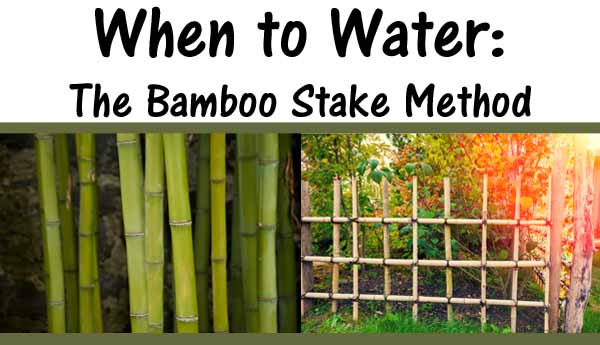
Bamboo stakes are the most practical and affordable gardening accessory I know, and they handle almost any light support job in the garden. They stake up newly planted trees, support vines, tomatoes, berry plants, grapes, peas, and beans, and hold up long-stem flowers so they do not flop over. You can lash them into teepees and trellises, use them as tool handles, dress up decorative railings, hold plant signs and row markers, build miniature hoop houses for row covers, and set up light garden fencing or edging.
The trick is matching the stake to the job. Pick a stake a little taller than the plant, set it close to the stem, and drive it in without punching straight through the root ball. If you want to see the range of sizes for these projects, you can browse bamboo garden stakes in our plant library. But did you know that the mighty bamboo stake can also tell you when and how much to water? That is where the method below comes in.
The Bamboo Stake Method: How to Tell When to Water
You tell when to water by pushing a dry bamboo stake into the root zone and reading the soil that clings to it when you pull it out. A clean, dry stake means the soil is dry and it is time to water. A stake with soil clinging to it means the soil is still moist, so you wait. This may sound like an odd and unconventional way to use a bamboo stake, but experienced plant people have used wooden skewers and chopsticks to gauge soil moisture for years.
Think of when you bake a cake. You poke a skewer in the middle to see if it is ready. If batter sticks to the skewer, it needs more time. If the skewer comes out clean, the cake is done. The principle here is just as simple: moist particles of soil adhere to the wood. It is the same idea behind the classic finger test, where you feel the soil to see whether it has dried out. The University of Illinois Extension recommends checking the top inch or two of soil with your finger and watering only when it feels dry, and the Clemson Cooperative Extension guide to watering indoor plants gives the same advice. A bamboo stake reads the same signal, just deeper and with a smaller, cleaner hole.
Here is the process step by step:
- Use a standard 1/2 inch diameter bamboo stake with no lacquer or plastic, since those coatings can throw off the reading. Make sure the stake is dry. I leave mine outside in a dry area all day.
- The length of the bamboo stake will vary with the size of the plant. Smaller plants with shallow roots take a shorter stake; bigger plants with deeper roots take a taller one.
- For new plants in the ground or potted plants, pick a spot just to the edge of the root ball from the plant base. Insert the stake straight down, about halfway down the root ball, wait a couple of seconds, then pull it up quickly.
- For older, more established plants in the ground, probe the soil just outside the canopy of the plant, at the drip line.
- Probe several spots (like the face of a clock: 12, 3, 6, and 9 o’clock) rather than one, because one section of the root ball may be dry while another is wet.
Now examine the stake and read it like this:
- A clean bamboo stake, with no soil sticking to it, means low soil moisture. You need to apply water.
- A light coating of soil particles indicates good soil moisture, so there is no need to water right now.
- A slightly muddy tip means the soil is getting saturated at the deepest level. No need to water, and you may be approaching overwatering.
- Evenly distributed flecks of soil along the stake indicate good moisture at all root-zone levels. No need to water.
With this method you can actually see the moisture levels on the stake itself, dry, damp, or wet, distributed along its length. Repeat the process after you water to check that you watered thoroughly enough, and run it before you water to confirm you need to in the first place. This method applies to plants whether they are in the ground or in containers.
Finger Test vs. Moisture Meter vs. Bamboo Stake
The bamboo stake wins when roots run deep, because it reaches the whole root zone and leaves a small, clean hole. Most gardeners already know the finger method and the moisture-meter method, and each has its place, so here is how they compare.
In the finger method, you insert a finger down to the second knuckle and feel. If it feels moist at the tip, you do not need to water. This gives you a good reading of the first two inches of soil, and that is all. For shallow-rooted potted plants such as houseplants, your finger works fine, though a bamboo stake makes a smaller, cleaner hole and disturbs the soil less. The trouble comes with a bigger plant and a larger root ball, where the root zone runs well below two inches. The key is to read the moisture about halfway down the root ball, which is often deeper than a finger can reach.
A sleek moisture meter is the other popular option, and it has real limits. The probe only samples one spot at one depth, so it does not tell you what is happening across the whole root zone. It can also give a false reading if the probe is dirty or corroded, so a quick wipe and a check in more than one spot help. For larger pots and older, more established plants whose roots go deep, a dry bamboo stake you can push as far as the roots reach is often the more dependable tool.
Does Bamboo Hold Up in Wet Soil?
Bamboo holds up reasonably well but it is not rot-proof. The canes are hollow and segmented, and mature bamboo has some natural resistance to rot and insects thanks to the silica in its walls. That resistance is limited, though. Untreated bamboo left in constant contact with wet soil will still weather, crack, split, and eventually rot, usually within one to two growing seasons.
A little care stretches that out. Let the stake dry between uses and keep the cut end out of waterlogged soil so it is not sitting in moisture. If you are preparing your own stakes, dry or cure cut bamboo in a shaded, airy spot rather than direct sun, which can split it, until the canes are hard and light. Cured, dry bamboo resists rot and insects better, and it gives a cleaner moisture reading, since a stake that is already damp will not show soil moisture clearly.
How Often Should You Water?
There is no fixed schedule, so check the soil first and do not water on autopilot. How often depends on the plant, the soil, the pot size, the age of the plant, the time of year, and the weather. The Clemson Cooperative Extension guide to watering shrubs and trees makes the same point: water based on actual soil conditions rather than a calendar, and remember that larger, deeper-rooted plants need you to check deeper in the soil.
During hot, dry, windy, or low-humidity conditions, you will need to check more often; in cool, still weather, less often. From repeated readings you will spot a pattern and settle into a rough schedule for each plant. One more thing I notice in the field: if the stake is hard to push in, the soil is probably compacted, and compacted soil sheds water or lets it run off instead of soaking in. In that case, loosen the soil and work in a soil conditioner so water actually reaches the roots.
Bamboo Stake and Watering FAQ
How do you use bamboo plant stakes?
Bamboo stakes support plants and do light jobs around the garden: staking newly planted trees, holding up vines, tomatoes, peas, beans, and berries, building trellises and teepees, propping tall flowers, marking rows, holding plant signs, and supporting row covers or light fencing. Pick a stake a little taller than the plant and set it close to the stem without driving it through the roots.
How do you use the bamboo stake method to know when to water?
Use a dry, unfinished bamboo stake (about 1/2 inch, no lacquer or plastic). Push it straight into the soil near the root zone, about halfway down the root ball or just outside the canopy at the drip line for established plants, wait a couple of seconds, and pull it out. A clean, dry stake means the soil is dry and it is time to water; a lightly soil-coated stake means moisture is fine, so wait; a muddy tip means the soil is saturated. Probe a few spots around the plant, since one side can be dry while another stays wet.
Does bamboo hold water, and does it rot when wet?
Bamboo canes are hollow and segmented, and mature bamboo has natural resistance to rot and insects, but that resistance is limited. Untreated bamboo left in constant contact with wet soil will still weather, crack, split, and eventually rot, usually within one to two growing seasons. Letting the stake dry out between uses and keeping the cut end out of waterlogged soil makes it last longer.
How do you dry or cure bamboo for stakes?
Let cut bamboo dry in a shaded, airy spot (not in direct sun, which can split it) until the canes are hard and light. Cured, dry bamboo resists rot and insects better and gives a more accurate reading when you use it for the moisture test, since a stake that is already damp will not show soil moisture clearly. Store stakes off the ground and dry between uses.
How often should you water a bamboo plant?
There is no fixed schedule; it depends on the plant, the soil, the pot size, and the weather, so always check soil moisture first. For a potted bamboo or lucky bamboo, water when the top inch or two of soil feels dry (lucky bamboo grown in water simply needs its water kept topped up and changed regularly). Note this is different from using a bamboo stake as a watering-test tool, which is what this method is about.
Sources:
- University of Illinois Extension
- Clemson Cooperative Extension (indoor plants watering)
- Clemson Cooperative Extension (watering shrubs and trees)
Garden Smarter With Green Thumb Nursery
The bamboo stake method is quick, simple, and effective, and the payoff is growing, watering, and caring for your landscape plants more successfully. If you have any garden or plant related questions, or you just need to find a cool plant, please stop by your favorite Green Thumb Nursery. You can visit your local Green Thumb Nursery and we will help you dial in a watering routine that works for your garden.
Do you like what you see? Sign up for our weekly newsletter to get content like this every week! CLICK HERE TO SIGN UP!