

Newsletter Articles
Fruiting Olive Trees: Best Varieties and How to Grow Them
By Richard Flowers, ACCNP, Green Thumb Nursery, Ventura
With their gnarled trunks and silvery, billowing canopies, olive trees are among the oldest cultivated plants in history, grown for more than 4,000 years. The olive is Olea europaea, the “European olive,” and in our Mediterranean-style Southern California climate it is right at home. If you want the beautiful tree and a crop of olives to go with it, here is how fruiting olives work, which varieties to choose, and how to grow them.
Quick answer: Not all olive trees bear fruit. Fruiting olives like Mission, Manzanillo, and Arbequina produce the familiar olives, while fruitless or ornamental varieties are bred to make little or no fruit (and much less pollen). Among the fruiting types, Mission is the versatile California classic for both oil and the table, Manzanillo is the big table olive, and Arbequina, Arbosana, and Koroneiki are the top choices for oil. Olive trees love full sun, are drought-tolerant once established, start bearing in about four years, and set a heavier crop when a second variety is planted nearby.
Do All Olive Trees Bear Fruit?
No. Fruiting olive varieties produce the olives you can cure or press for oil, but there are also fruitless, ornamental olives bred to make little or no fruit. UC lists cultivars such as Majestic Beauty, Swan Hill, Wilsoni, and the dwarf Little Ollie as fruitless choices, and notes that fruitless varieties are less likely to aggravate allergies because they produce less pollen (UC IPM). That matters because fruiting olives have two downsides in a yard: their dropped ripe fruit stains pavement and patios, and olive pollen is a notably strong allergen (UC IPM). So if you want the silvery tree without the mess or the pollen, choose a fruitless variety. If you want olives to eat or press, read on: this guide is about the fruiting kinds.
Is an Olive a Fruit?
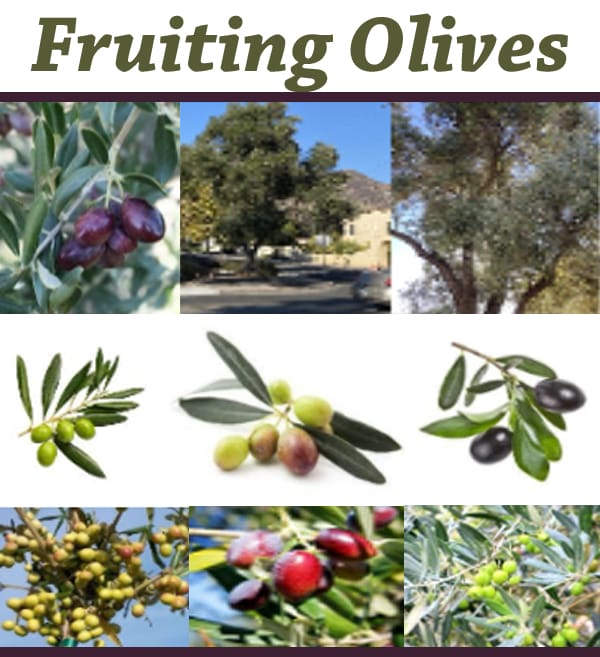
Yes. Botanically, an olive is a fruit, specifically a drupe, or stone fruit, with a single hard pit inside, like a peach or cherry (NC State Extension). The olive starts as a green drupe and ripens to purple-black. The tree belongs to the olive family, Oleaceae, which also includes ash, jasmine, and lilac.
Best Fruiting Olive Varieties
There are hundreds of olive cultivars. Here are the ones we are most often asked about, with whether each is best for the table, for oil, or both.
| Variety | Best use | Fruit | Notes |
|---|---|---|---|
| Mission | Oil and table | Medium, deep purple to black | The California classic; vigorous, heavy-bearing, and the most cold-hardy |
| Manzanillo | Table (and oil) | Large, rounded; purple to blue-black | The classic “California-style” black table olive; ripens early; resists bruising |
| Arbequina | Oil | Small, very high oil | A top California oil variety; compact and upright; great for high-density plantings |
| Arbosana | Oil | Small; ripens later than Arbequina | Robust-flavored oil; compact; complements and helps pollinate Arbequina |
| Koroneiki | Oil | Very small | The primary oil variety of Greece; high yield; prized, high-quality oil |
| Pendolino | Pollinizer (and oil) | Small | Weeping, cold-hardy; mainly a pollinizer, often paired with Frantoio |
| Frantoio | Oil | Medium | The classic Tuscan-style oil olive; high-yielding and fruity |
Mission is the most versatile for a home garden: deep purple fruit ripening to jet-black, good for both pickling and oil, and it is the most widely used olive for cold-pressed oil in California. Manzanillo is the big, rounded table olive, rich when pickled and eaten both green and ripe-black. Arbequina has become California’s top oil variety, with mild, sweet, low-bitterness fruit very high in oil; pair it with Arbosana for better yields. Koroneiki, from Greece, carries very small fruit but excellent oil, and Pendolino and Frantoio round out the Italian oil options. Availability shifts with demand, so call ahead to check on a specific variety.
How Long Until an Olive Tree Bears Fruit?
An olive tree reaches bearing age in about four years (California Rare Fruit Growers). Fruit is borne on the previous year’s growth, so steady, moderate pruning keeps a tree productive year after year. If you want larger olives, thin the crop soon after fruit set, down to about two or three olives per foot of twig.
Do Olive Trees Need a Pollinator?
Olives are wind-pollinated, and most varieties are self-pollinating, so a single tree will usually set some fruit (California Rare Fruit Growers). That said, fruit set is usually improved by cross-pollination with a second variety, and because some cultivars are self-sterile, olives are often planted in pairs: a main variety plus a compatible pollinizer (The Olive Oil Source). If you have room for two trees, you will get a heavier crop.
How to Grow Fruiting Olives
Olives are famously tough, but to fruit well they need the right conditions. Plant them in full sun in well-drained soil (NC State Extension). They need a long, hot summer to ripen the fruit and a period of winter chill to set it, and very mild winters (average temperatures too warm) will actually reduce fruiting (California Rare Fruit Growers). The tree is hardy down to roughly the low-to-mid teens Fahrenheit, though green fruit is damaged at about 28 degrees. Once established, olives are very drought-tolerant: a monthly deep soaking is usually plenty, and they dislike soggy winter soil. Feed with nitrogen before flowering so the tree can use it before fruit set, but do not overdo it, because too much nitrogen gives you leaves instead of olives. Do not be alarmed by some leaf drop in spring, which is normal as old leaves are replaced.
Harvesting and Using Olives
Olives for green curing are picked once they reach full size but are still green; you can also pick them later, all the way through full ripeness. Ripe olives bruise easily, so handle them gently. There are several classic ways to cure olives at home. Pressing your own olive oil, on the other hand, is not practical for most households, because the equipment and the sheer mass of fruit required are beyond a backyard crop.
Fruiting Olives in the Landscape
In the garden, fruiting olives are easy and striking, but site them thoughtfully: keep them away from patios, walkways, and driveways so dropped ripe fruit does not stain the paving. They have few pests, deer tend to leave them alone, and their gray-green foliage makes a beautiful accent or specimen. With no open ground, grow one in a large decorative container or even train it as a sculptural bonsai. Olives pair beautifully with other Mediterranean plants such as pomegranate, citrus, rosemary, sweet bay, lavender, sages, and Italian cypress. For a backyard orchard, some growers use a super-high-density (SHD) system, training compact oil varieties like Arbequina, Arbosana, and Koroneiki on a two-wire trellis in rows about 4 to 6 feet apart.
Frequently Asked Questions
Do all olive trees bear fruit?
No. Fruiting olive varieties such as Mission, Manzanillo, and Arbequina produce olives, but fruitless or ornamental olives (like Swan Hill, Wilsoni, Majestic Beauty, and Little Ollie) are bred to make little or no fruit. Those fruitless types also produce much less pollen, so they are popular where fruit litter or pollen allergies are a concern.
Is an olive a fruit?
Yes. Botanically an olive is a fruit, specifically a drupe, or stone fruit, like a peach or cherry, with a single hard pit inside. It starts green and ripens to purple-black.
What is the difference between Arbequina and Mission olives?
Mission is the versatile California classic, good for both olive oil and cured table olives, vigorous and the most cold-hardy. Arbequina is a smaller, compact tree grown mainly for its mild, high-quality oil, and is a favorite for high-density plantings. In short: Mission for all-around use, Arbequina for oil.
How long does it take an olive tree to bear fruit?
Most olive trees begin bearing in about four years. Fruit forms on the previous year’s growth, so steady, moderate pruning keeps the tree productive.
Do olive trees need a pollinator?
Olives are wind-pollinated, and most varieties are self-fruitful, so a single tree will usually set some fruit. You will get a heavier crop by planting a second compatible variety nearby, and a few cultivars are self-sterile and require a pollinizer.
Do ornamental olive trees produce fruit?
Ornamental (fruitless) olive varieties are bred to produce little or no fruit, which is the whole point: you get the beautiful silvery tree without the mess of dropped olives or the heavy pollen of a fruiting variety.
How do you get an olive tree to produce more fruit?
Give it full sun and a long, hot summer, make sure it gets some winter chill (very mild winters reduce fruiting), avoid over-fertilizing with nitrogen, which favors leaves over fruit, and plant a second variety nearby to improve pollination.
Sources
- UC IPM, Olive (Home and Landscape)
- UC IPM, Olive Pest Notes (fruitless cultivars and allergies)
- NC State Extension, Common Olive (Olea europaea)
- California Rare Fruit Growers, Olive Fruit Facts
- The Olive Oil Source, Olive Tree Selection
- The Olive Oil Source, Olive Pollination and Fruit Set
Fruiting olives are stately, long-lived, and rewarding, whether you want a Mediterranean focal point, a few jars of cured olives, or a small backyard oil orchard. Come by your favorite Green Thumb Nursery location to see which olive varieties we have in stock, and if you are planning a fruit-tree garden, see our guides to keeping fruit trees small and choosing the right rootstock.
Do you like what you see? Sign up for our weekly gardening newsletter to get content like this every week.