

Newsletter Articles
What Is a Drip Line?
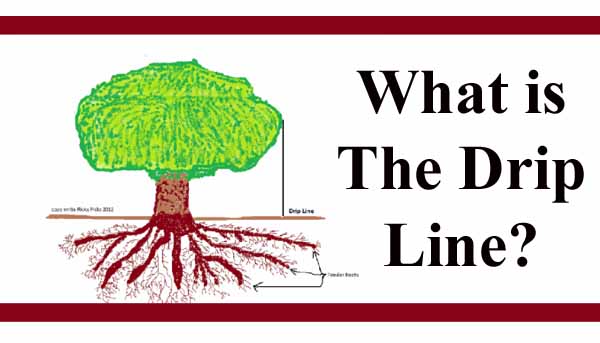
By Richard Flowers, ACCNP, Green Thumb Nursery, Ventura
Short answer: The drip line is the circle on the ground directly under the outermost tips of a tree’s branches, right where rain drips off the edge of the canopy. It matters because the feeder roots that take up water and nutrients live out there, not against the trunk. Water and fertilize at the drip line and a few feet beyond, never up against the trunk.
Last week I mentioned a very important keyword called the drip line. Just what is the drip line, and why is it important? Imagine a tree or shrub is like an umbrella. When it is raining and you have an umbrella, you stand directly under it and you remain dry. The outer edges of the umbrella are where the water drips off. The same principle applies to plants. The farthest extent of the leaves and branches is the drip line. During rainy weather, if you stand directly under a tree you will notice it is much drier than if you were out in the open. For example, say a tree’s branches reach out about 15 feet from the trunk. That circle on the ground, roughly 15 feet out, is the drip line.
Where to Water and Fertilize
The drip line, and extending several feet beyond it, is where you apply your water and your fertilizer. The ground beneath the drip line is called the drip zone. Basically, what you see above ground is more or less mirrored below ground, and then some. The drip line is where the small feeder roots (the rootlets that carry the fine root hairs) do their work, bringing water and nutrients up to the plant.
These feeder roots are not located next to the trunk, that is not where you water and fertilize. If you water right up against the trunk, you greatly increase the likelihood of crown and trunk rot (UC IPM). When you water deeply, apply it at the drip line and out several feet beyond, for more on how far water really soaks in, see our guide on watering when it rains.
Where a Tree’s Roots Really Are
A tree’s roots reach farther than most people think. The larger roots, generally in the top 6 to 24 inches of soil, are mainly for anchorage and for storing carbohydrates. Branching off them, from the sides and ends, are the feeder roots: tiny roots about 1/16 of an inch across, carrying the even finer root hairs, that grow up toward the soil surface and spread outward past the drip line. These feeder roots are the ones that actually absorb moisture, and most of them sit in the top 12 to 18 inches of soil.
The root system as a whole commonly spreads to about one-and-a-half times the distance from the trunk to the drip line, with more than half of the absorbing roots out beyond the drip line (ISA, Arboriculture & Urban Forestry; University of Minnesota Extension). That is exactly why watering at the drip line and a few feet beyond works, while watering at the trunk does not.
How Water Moves Through the Soil and the Plant
It helps to understand how water actually moves so you can water efficiently during a drought. When water is applied at the drip line, it seeps down gradually to the root zone where the feeder roots are. It keeps moving down, filling each layer of soil to field capacity before moving into the next. This advancing boundary is called the wetting front. Field capacity is the amount of moisture the soil holds after the excess has drained away. Water moves downward through sandy (coarse) soils faster than through clay (finer) soils.
From the root zone, water travels up into the stems and leaves through tiny tube-like structures, like straws, called the xylem. The leaves have microscopic openings called stomata, and the loss of water vapor through those stomata is called transpiration. When transpiration pulls water out faster than the roots can replace it, the plant loses its firmness and you see wilting, unless water is replenished at the root zone so the feeder roots can keep up. Then the whole process starts over again. That is why a slow, deep soak at the drip line beats a quick sprinkle: the water has time to fill each layer and reach the feeder roots in the top 12 to 18 inches of soil (University of Minnesota Extension).
Mulch Out to the Drip Line
One more way to put the drip line to work: mulch. Spread a 2-to-3-inch layer of mulch from near the trunk out toward the drip line to hold moisture and feed the soil, but keep it pulled back a few inches from the trunk itself. Never pile mulch up against the bark in a “volcano,” which traps moisture against the trunk and invites the very rot you are trying to avoid (Penn State Extension). If a tree is already struggling, our guide on how to revive a dying plant can help.
See our nursery staff; we would be happy to assist you with any of your gardening concerns and questions.
Sources:
Do you like what you see? Sign up for our weekly newsletter to get content like this every week!
Drip Line FAQs: What It Is and Where to Water
What is a drip line?
A drip line is the imaginary circle on the ground directly beneath the outermost tips of the branches of a tree or plant, like the edge of an umbrella where rain drips off. If a tree is 15 feet wide, its drip line sits about 15 feet out from the trunk. If you are looking for the watering system instead, see our guide to drip irrigation systems.
What is the drip zone?
The drip zone is the ground beneath the drip line. Roughly, what you see above ground is mirrored below ground, so the drip zone is where most of the active roots are found.
Where should you water and fertilize a tree?
Water and fertilize at the drip line and a few feet beyond, not against the trunk. The feeder roots that absorb water and nutrients grow near the surface out around the drip line, so watering at the trunk does little for the tree and raises the risk of rot.
Where is the drip line on a tree?
To find the drip line, look straight up to the outermost tips of the branches, then down to the ground directly below them.
- Stand back and find the outermost tips of the branches.
- Follow those tips straight down to the ground.
- Picture the circle they trace around the trunk, about as far out as the branches reach. That circle is the drip line.
What is the drip line of a plant?
The same idea applies to shrubs and smaller plants, not just trees: the drip line is the ground below the farthest reach of the leaves and stems, and that is where the feeder roots take up water.
Related: how to check soil moisture with the bamboo stake method.