

Newsletter Articles
Coral Bells (Heuchera): Colors, Care, and How to Grow Them
By Richard Flowers, ACCNP, Green Thumb Nursery, Ventura
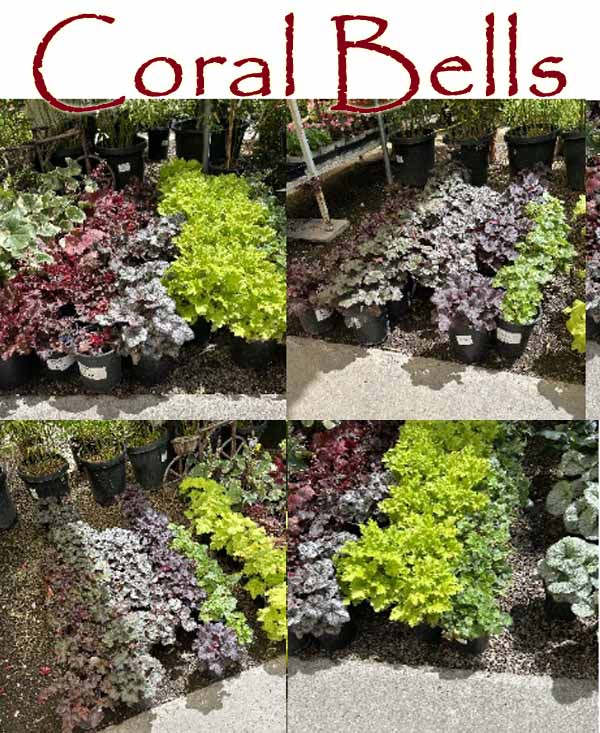
Over the past several years, an explosion of coral bells varieties with striking leaf shapes and colors has arrived to beautify gardens and landscapes. I want to introduce you to this darling, under-appreciated plant and show you why it deserves a spot in your yard.
Quick answer: Coral bells are the common name for Heuchera, a North American perennial grown for its mounds of colorful evergreen to semi-evergreen foliage in shades of green, bronze, silver, lime, caramel, and deep red, topped by airy, bell-shaped flowers that draw hummingbirds. They are at their best in part shade with moist, well-drained, slightly acidic soil, though many varieties take more sun in cooler spots. Coral bells are compact, deer-resistant, and easy to grow, and they are grown as ornamentals, not as food. The ASPCA lists them as non-toxic to dogs, cats, and horses.
What Are Coral Bells?
Coral bells are better known in botanical circles by their genus name, Heuchera (pronounced HEW-ker-ah), and by a third common name, alumroot (NC State Extension). The genus honors Johann Heinrich von Heucher, an Austrian-born medical botanist and professor in 17th-century Wittenberg, Germany; Carl Linnaeus named the genus in his honor. The common name “coral bells” comes from the little bell-shaped flowers, said to have a coral-like color.
Coral bells are native to North America, growing wild across the United States, Canada, and Mexico in rocky, wooded places, often in thin soils right out of the rocks and along moist mountain creeks (NC State Extension). Of the roughly 50 Heuchera species, all but one are North American; the single outlier is native to the Russian Far East, but it is not a plant you will find in a garden center.
Coral Bells Foliage and Flower Colors
Coral bells are grown first and foremost for their foliage. They form tidy clumps, often a rosette of decorative leaves ranging from lush green to bronze, silver, yellow, lime, caramel, and reddish, depending on the selection. The lighter-colored varieties shine in a lightly shaded garden, while dark-leaved types make yellow-flowered plants like coreopsis glow and bring out the tones of simple green leaves nearby. They are lovely woven into a rich patchwork of color and texture under tall trees where light filters through the branches.
Above the leaves, coral bells send up tiny, nodding, bell-shaped flowers on slender, wiry stalks that rise about 1 to 2.5 feet. The blooms come in white, pink, coral, rose, and magenta, and while each is small, in masses they look lovely swaying in a light breeze. The flowers attract hummingbirds, butterflies, and bees (NC State Extension), and they make excellent cut flowers for bouquets.
How to Grow and Care for Coral Bells
Coral bells are easy to grow when you match them to the right spot. Here is what they want.
| Feature | Detail |
|---|---|
| Botanical name | Heuchera (genus); also called alumroot |
| Plant type | Evergreen to semi-evergreen perennial |
| Foliage | Mounding rosette in green, bronze, silver, lime, caramel, or red |
| Flowers | Airy, bell-shaped, white to pink, coral, and red; attract hummingbirds |
| Light | Part shade is best; many varieties take full sun in cooler spots |
| Soil | Moist, well-drained, slightly acidic, rich in organic matter |
| Mature size | Foliage mound about 8 to 18 inches; flower stalks 1 to 2.5 feet |
| Hardiness | USDA zones 4 to 9 |
| Traits | Deer-resistant, salt-tolerant, hummingbird-friendly; short-lived (divide every few years) |
Coral bells prefer a slightly acidic soil, moist but well-drained, amended with organic matter such as leaf compost or pine bark, so an acid planting mix is a good choice (NC State Extension). Plant them in late fall or early spring. They tolerate dry soil once established but thrive with regular water, and they are salt tolerant, deer resistant, and easy to grow. Feed with a balanced, slow-release fertilizer in spring and again mid-season, and keep a healthy layer of mulch over the soil to conserve water and keep the roots cool during heat waves.
How Big Do Coral Bells Get?
Coral bells stay compact. The foliage forms a low mound roughly 8 to 18 inches across, and the airy flower stalks rise about 1 to 2.5 feet above the leaves (NC State Extension). That modest size makes them ideal for the front of a border, for edging, for tucking around boulders or the base of a fountain or tree, and for pots, troughs, and window boxes.
Do Coral Bells Need Sun or Shade?
Coral bells grow in sun or shade depending on the variety, but part shade is the safest choice. Many varieties develop their richest leaf color in more sun, yet in hot, dry conditions full sun can scorch the leaves. For most Southern California gardens, give them at least part shade with good drainage, ideally with protection from harsh afternoon sun, and they will reward you with clean, colorful foliage.
Are Coral Bells Edible or Poisonous?
Coral bells are grown as ornamental plants, not as food, and the ASPCA lists them as non-toxic to dogs, cats, and horses (ASPCA). The name alumroot comes from the roots of some species, which contain alum and were historically used as a powerful astringent, for example to help stop bleeding (NC State Extension). That is a historical and medicinal note, not a cooking suggestion: coral bells are an ornamental, nursery plants are not grown as food, and they should be enjoyed for their looks rather than eaten.
How to Keep Coral Bells Thriving
Coral bells are somewhat short-lived perennials, so a little maintenance keeps them vigorous for years. Divide the clumps about every 2 to 4 years to prolong their life. On older plants the rootstock tends to grow upward and look woody; when that happens, lift the plant and replant it with the crown just above the soil, ideally in early spring. Deadhead spent flowers to encourage more blooms through summer and into fall, and if the leaves look ragged, prune them and fresh new growth will follow. A layer of mulch protects the roots if temperatures drop below freezing for a prolonged period.
Ways to Use Coral Bells in the Garden
Coral bells are wonderfully versatile. Use them as edging in perennial borders, in group plantings, or in small irregular drifts for a woodland or naturalistic rock-garden feel. In a more formal garden, plant them as a mass focal point or a crisp linear edge. They are excellent viewed up close in smaller gardens, and they shine in containers as a foliage accent. Try pairing them with liriope, ferns, hydrangeas, begonias, boxwood, agapanthus, Japanese maples, and clivia, or plant them in large swaths to bring out the color and contrast of nearby flowering plants.
Frequently Asked Questions
What is another name for coral bells?
Coral bells are also known by their botanical name, Heuchera (pronounced HEW-ker-ah), and by the common name alumroot. All three names refer to the same North American perennial.
Are coral bells and Heuchera the same plant?
Yes. “Coral bells” is simply the common name for the genus Heuchera, so you will see the same plants sold under either name.
Are coral bells evergreen?
In mild climates like Southern California, coral bells are evergreen to semi-evergreen and hold their colorful foliage through the year. In very cold regions they may die back and return in spring.
Are coral bells edible or poisonous?
Coral bells are grown as ornamentals, not as food, and the ASPCA lists them as non-toxic to dogs, cats, and horses. The roots of some species were historically used as an astringent, which is where the name alumroot comes from, but nursery plants are ornamentals and should not be eaten.
How big do coral bells get?
Coral bells form a low mound of foliage about 8 to 18 inches across, with airy flower stalks that rise roughly 1 to 2.5 feet above the leaves.
Do coral bells need sun or shade?
Coral bells do best in part shade. Many varieties color up well in more sun, but in hot, dry conditions full sun can scorch the leaves, so part shade with good drainage is the safest choice.
Are coral bells perennials?
Yes, coral bells are perennials, though somewhat short-lived. Dividing them every 2 to 4 years and replanting the crown keeps them vigorous for many years.
Are coral bells deer-resistant?
Yes. Coral bells are deer-resistant and also salt-tolerant, which makes them a dependable choice for tough spots where other plants struggle.
Sources
- NC State Extension, Coral Bells (Heuchera americana)
- NC State Extension, Heuchera americana (range, soil, roots and alum, zones)
- NC State Extension, Heuchera (genus: flowers and pollinators)
- ASPCA, Coral Bells (non-toxic to pets)
- ASPCA, Alumroot (non-toxic to pets)
Coral bells really are a great plant for those difficult, lightly shaded spots in the garden. Stop by your favorite Green Thumb Nursery location and check out the colorful coral bells varieties we carry, along with other cool plants almost every gardener will crave. They also make a lovely companion to the shade-loving ground covers we grow.
Do you like what you see? Sign up for our weekly gardening newsletter to get content like this every week.